
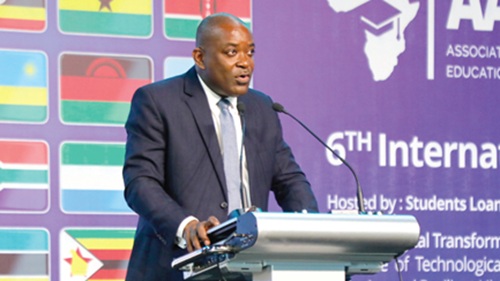
The Director General of the Ghana Tertiary Education Commission (GTEC), Professor Ahmed Jinapor, has hailed the government’s No Fees Stress Policy as one of the most audacious policies in the history of tertiary education in the country.
He said the policy was built on a simple, morally urgent premise that no qualified Ghanaian student should be turned away from a lecture hall or forced to withdraw from one for want of funding.
Prof. Jinapor explained that it was delivered through four coordinated pillars: No-Academic-Fees Policy for first-year students, Free Tertiary Education initiative for Persons with Disabilities, an enhanced Students Loan Plus facility, and a reformed Traditional Student Loan Scheme.
“No discussion of inclusion in Ghana's higher education financing would be complete without speaking to what I consider as one of the most audacious policies in the history of our tertiary education system: the No Fees Stress Policy, the flagship initiative of President John Dramani Mahama,” he emphasised.
Prof. Jinapor said this in a keynote address at the Sixth Association of African Higher Education Financing Agencies (AAHEFA) International Conference in Accra last Monday.
The two-day event was on the theme: "Digital Transformation in Higher Education Financing: The Role of Technological Advancements in Ensuring Sustainable, Inclusive and Resilient Higher Education Financing System in Africa.
The Director-General of GTEC said under the No-Academic-Fees Policy alone, 321,680 students had so far been validated, reimbursed or enrolled.
They included 152,698 first-year students whose 2024/25 fees were reimbursed as well as a further 168,982 beneficiaries paid directly so far this academic year through direct-to-institution disbursement.
Facility
The Students Loan Plus facility, Prof. Jinapor added, had supported 1,997 students with full fee coverage, 626 of them at the Ghana School of Law alone, disbursing over GH¢20.7 million.
“The traditional Student Loan Scheme, now enhanced, reached 59,307 students in the 2025/26 academic year, disbursing over GH¢210.6 million.
“Taken together, across all four pillars of this policy, more than 384,600 Ghanaian students have now benefited, and the number continues to climb with every disbursement cycle.
This is not incremental growth. This is a structural expansion of who gets to call themselves a Ghanaian graduate,” he explained.
The Free Tertiary Education initiative for Persons with Disabilities, Prof. Jinapor said, was an affirmative action in its truest sense and a deliberate decision by government to name disability as a financial barrier and remove it, not merely acknowledging it.
He said the policy defined disability broadly and compassionately, spanning physical, sensory, communication, developmental, and psychosocial conditions, so that no student was excluded from support based on a technicality of definition.
Beneficiary
“For every validated beneficiary, the policy covers full academic fees, residential fees in public tertiary accommodation, and, as resources allow, stipends and assistive learning devices.
In the current 2025/26 academic year alone, 1,623 students with disabilities have received this support,” he said.
Prof. Jinapor said inclusion was not an afterthought grafted onto the Students Loan Trust Fund (SLTF) and that it ran through its foundations.
He said inclusion was not only about who a policy named, but it was also about how reach was delivered in practice.
“For a rural student without a formal guarantor, our No-Guarantor Loan Scheme, made possible by digital means-testing rather than a demand for social connections, has opened a door that once stayed firmly shut.
“And for the informally employed graduate who has no payslip and no fixed address, agencies like Tanzania's Higher Education Students' Loans Board have shown that a simple mobile micro-payment channel can bring that graduate back into the repayment system far more humanely than a summons or a published notice ever could,” he said.
Technology
He said technology, when used well, did not merely digitise privilege that already existed and that “it extends reach to precisely those students our systems have historically found hardest to see.”
He commended the President for the bold intervention and acknowledged the leadership behind its implementation, “Dr Saajida Shiraz, our host and Chief Executive Officer, who brings scholarly depth and practical governance experience to this role”
Under her stewardship, he said interest rates on student loans had nearly halved while a no-guarantor scheme had opened doors once closed to students without surety, in addition to the disability initiative that had come fully to life.
“Dr Shiraz, on behalf of GTEC and every Ghanaian student who has benefited from these reforms, I thank you for your leadership and congratulate you on hosting this conference,” he said.
Prof. Jinapor said every SLTF applicant today must present a valid Ghana Card, an active mobile number, and an E-zwich card before a loan can be considered – a modest but deliberate step toward anchoring student financing within the same digital identity infrastructure that increasingly underpinned the national payment systems.
Disbursement
Disbursement too, he said, was moving away from cash and cheque and that first-year students under the No-Academic-Fees Policy were paid directly to their institutions through digital, direct-to-institution transfers, and public tertiary institutions now submitted validated disability data to the SLTF electronically through a dedicated institutional portal, rather than the paper files of even a decade ago.
He said the law establishing the SLTF required an internal auditor to report on the fund's books every three months, a full external audit by the Auditor-General every year, and an annual report laid directly before Parliament – obligations that predated the digital era but whose spirit, complete visibility of how public money was raised and spent, “is exactly what digital tools now allow us to deliver in something closer to real time”.
