
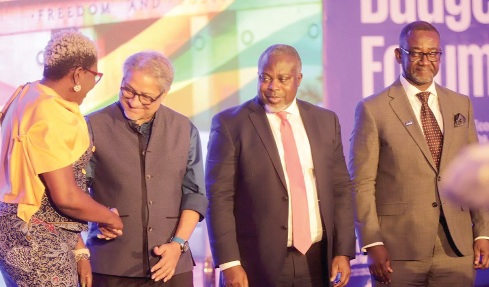
The Commissioner-General of the Ghana Revenue Authority (GRA), Anthony Kwasi Sarpong, has said the Authority will leverage digital administration, automated Value Added Tax (VAT) collection, a broader tax base and improved taxpayer compliance to achieve its target of increasing non-oil tax revenue from GH¢153.5 billion in 2024 to GH¢310 billion by 2028.
These strategies, he said, intensify efforts to improve revenue mobilisation without imposing new taxes.
The move comes amid the government’s commitment to introducing no new taxes in the 2027 Budget, while intensifying increased domestic revenue mobilisation to finance its development priorities.
Mr Sarpong was speaking at the KPMG/UNDP Ghana Budget Forum 2026, on the theme: “No New Taxes, Better Collection: Financing Ghana’s New Economy Together.”
The forum brought together policymakers, businesses and other stakeholders to dialogue on the national budget regarding what it meant for businesses, livelihoods and Ghana’s long-term development.
“In 2027, the GRA will deepen digital administration, automate VAT, widen the base rather than the burden, treat taxpayers as partners, invest in our people, and uphold integrity within the Authority.
These priorities support the target I set at the start of my tenure: to more than double non-oil tax revenue, from GH¢153.5 billion in 2024 to GH¢310 billion in 2028,” he stated.
Revenue mobilisation
He emphasised that achieving the target would require a collective commitment from businesses, tax advisers and development partners to strengthen voluntary compliance and improve domestic revenue mobilisation.
He, therefore, urged businesses to register with the GRA, file accurate tax returns, pay their taxes on time and issue proper receipts for transactions.
The Commissioner-General said the GRA would prioritise fairness, transparency and ease of compliance, stressing that effective revenue collection was essential to financing Ghana’s development without excessive reliance on external support.
Ghana will mark 70 years of independence in 2027, a milestone Mr Sarpong said should reinforce the importance of domestic revenue mobilisation and national ownership of the country’s development.
“Taxes are the purest form of national ownership.
They finance the country we choose to build, without asking permission from anyone else.
“No new taxes. Better collection. A stronger Ghana.
That is our commitment for 2027,” he added.
Opportunities
The Country Managing Partner (CMP) of KPMG in Ghana, Andrew Akoto, said the allocation of GH¢100.4 billion to direct capital expenditure and GH¢30 billion to the New Economy Programme in the 2027 Budget presents an opportunity to strengthen Ghana’s productive sectors and stimulate economic activity.
However, he said the priority should now be to ensure that the planned investments translate into tangible benefits for businesses and the wider economy.
He noted that the combined GH¢130.4 billion allocation could support economic growth, but its impact would depend largely on how effectively the investments addressed the operational challenges facing businesses.
He explained that investment in the energy sector must translate into reliable and predictable electricity supply, while improved access to finance should provide viable businesses with the capital needed to expand their operations.
He further stressed that investments in agriculture and industry must strengthen value chains, improve access to markets and create sustainable employment opportunities.
He said although this year’s findings showed growing optimism about the economic outlook, persistent pressures in the day-to-day operating environment remained a concern for businesses.
He emphasised that macroeconomic progress would become meaningful when reflected in improved business conditions that enabled companies to invest, expand and create jobs.
He therefore called for greater attention to maximising the impact of public investments across the economy, particularly by ensuring that allocations to productive sectors deliver measurable improvements in business operations and economic activity.
For his part, the Coordinating Director, Technical, Ministry of Finance, Samuel Arkhurst, said the ultimate measure of success should be the prosperity of every Ghanaian.
"The New Economy agenda presents an opportunity to strengthen domestic enterprises, deepen local value chains and support businesses operating in sectors such as agriculture, agro-processing, manufacturing, tourism and technology,” the UNDP Resident Representative, Niloy Banerjee, said.
