
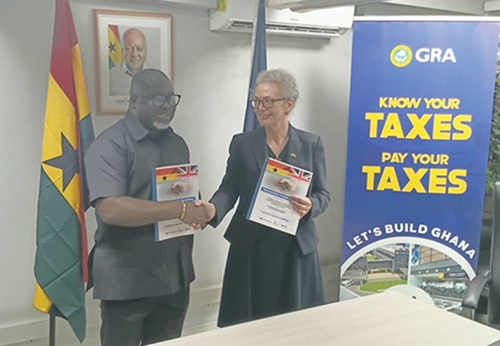
The Ghana Revenue Authority (GRA) has signed a Memorandum of Understanding (MoU) with His Majesty’s Revenue and Customs (HMRC) of the United Kingdom (UK) to deepen cooperation on customs modernisation.
The initial focus of the cooperation with the UK authority responsible for tax, payments and customs will be on post-clearance audit.
The agreement, which was signed in Accra last Friday, builds on nearly a decade of collaboration between the two revenue administrators, and forms part of the wider Ghana-UK Growth Partnership launched by President John Dramani Mahama and the UK Prime Minister in London in June this year.
Under the agreement, customs would be able to examine traders' records, systems and transactions after goods have been cleared, allowing intervention to be targeted at higher-risk traders while easing the processes for compliant businesses.
The partnership, which will be delivered through HMRC's Accelerated Trade Facilitation Programme, will provide technical assistance, peer-to-peer learning, capacity building and exchange of knowledge.
The Commissioner-General of the GRA, Anthony Sarpong, signed on behalf of the GRA, while the Development Director at the British High Commission, Terri Sarch, signed on behalf of HMRC.
Commitment
The Commissioner-General, who traced Ghana's customs cooperation with the UK to more than 200 years back, said the MoU represented a shared commitment to strengthening institutions, improving the environment for legitimate trade and supporting Ghana's economic ambitions.
Mr Sarpong explained that the partnership would help to shift away from reliance on physical interventions at the border towards a more risk-based model of compliance.
He said the effective post-clearance audit would help GRA to achieve stronger compliance and protection of government revenue on one hand, and easier legitimate trade on the other hand.
He added that while GRA would benefit from HMRC's international experience, Ghana's own expertise, built over 200 years of customs administration, would also be shared with the UK and other countries.
Mr Sarpong linked the MoU to GRA's broader reform agenda, which covered people and culture, enhanced revenue mobilisation, innovation and technology transformation, governance and operational excellence, data and insights, and stakeholder trust.
"The authority's goal is not simply to collect more revenue but to build a modern, intelligence-led, technology-enabled and taxpayer-focused administration.
"The future of customs administration must be increasingly digital, data-driven and risk-based, providing better service to compliant traders while maintaining strong controls against non-compliance and revenue leakages," he said.
Mr Sarpong said GRA's immediate priority would be to translate the goals of the MoU into a clear programme of practical activity with measurable outcomes, adding that there was a scope to explore other areas of cooperation with HMRC over time.
Milestone
Ms Sarch described the signing as a milestone in the UK's long-standing partnership with the GRA, adding that the MoU marked the beginning of HMRC-GRA cooperation specifically on customs revenue, building on earlier work on domestic resource mobilisation that had delivered real increases in revenue for public services.
The agreement, she said, was designed to help Ghana strengthen its customs systems and post-clearance audit unit, and to support the implementation of the World Trade Organisation's (WTO) Trade Facilitation Agreement.
Ms Sarch said trade facilitation reforms would reduce the time and cost of moving goods across borders while improving transparency and predictability for businesses.
"The benefits will extend to government, customs administrations, traders, investors and consumers alike," she said.
