
The Minister of Roads and Highways, Governs Kwame Agbodza, has called for local production of polymer-modified (PG) bitumen to end the country’s reliance on imports and secure supplies for the government’s Big Push road projects.
He said the increasing use of PG bitumen in trunk road construction made domestic production essential to reduce dependence on neighbouring countries and other international suppliers.
Although the immediate supply shortfall would be addressed through alternative sources, he said the government was pursuing a sustainable local production arrangement to prevent future shortages and project delays.
"If this is the route the country is taking, that our trunk roads will now be built with bitumen, then it is essential that we develop the capacity to produce it locally," he said.
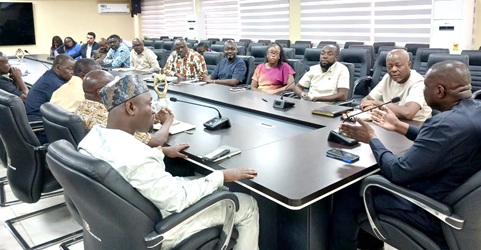
Speaking during a meeting with bitumen suppliers and other industry players at the ministry yesterday, Mr Agbodza said as part of measures to improve the supply and quality assurance arrangements, the ministry had, with immediate effect, initiated steps to install additional testing facilities in Accra, Kumasi and Tamale to decentralise the testing of bitumen products.
He said the move would enable the authorities to test bitumen supplied outside Accra without having to transport samples to the capital.
“So far, they have been able to supply fuel and all other emulsions without any problem. The only challenge is with the polymer-grade bitumen, and once we resolve this we can be assured that the projects will proceed.
Supply
“So, there is no fear for anybody to think that the Big Push projects are going to be delayed because we are unable to supply polymer-grade bitumen as a country,” he said.
The meeting allowed the participants to discuss supply challenges affecting the availability of polymer-modified bitumen for road construction.
It followed a field inspection the minister embarked on to assess the progress of work on various road projects along the Eastern Corridor road projects, from November 10 to 11, this year.
During the inspection, several contractors, including Greenhouse International Limited, which is undertaking the 53.35-kilometre Have-Hohoe road project, and contractors working on the Tamale Outer Ring Road projects, identified delays in the supply of polymer-modified (PG) bitumen as a major constraint to the timely execution of their projects.
It emerged that most of the contractors had completed the sub-base works and were progressing with the base construction, requiring bitumen to undertake the binder course, particularly as the dry season provided favourable conditions for road works.
However, placing orders for the material, the contractors said supplies had not been delivered on time, a situation that was affecting the pace of work and contributing to delays in project execution.
Capacity
Mr Agbodza said Ghana should be capable of producing the material, particularly when neighbouring countries such as Togo and Cote d'Ivoire had demonstrated the ability to supply it.
"When we are saying it can be supplied in Togo, a smaller country, and Cote d'Ivoire, our neighbours, I think Ghana should be able to deal with it," he said.
He observed that the country was spending substantial amounts of public funds on bitumen for road construction, and questioned why such expenditure should continue to support production capacities outside the country.
He said the Ministry of Food and Agriculture had resolved to produce more eggs and chickens.
"We are spending multiple folds of government money on bitumen than what we are putting in the production of chicken and other things.
