
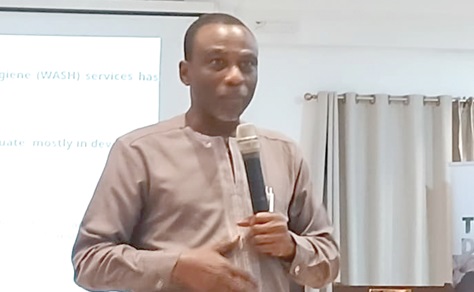
The inability of the government to release early funds allocated to water, sanitation and hygiene (WASH) is threatening efforts to tackle the country’s worsening water crisis and build resilience against climate change, WaterAid Ghana, has said.
The organisation is consequently calling for an urgent shift in the government financing priorities to ensure that the estimated $1.7 billion required annually for WASH was fully mobilised and effectively deployed.
The Head of Strategy, Policy and Campaigns at WaterAid Ghana, Ibrahim Musah, said although the government had committed to investing $1.7 billion annually in WASH, budget execution had historically remained between 50 and 60 per cent.
He said the situation was undermining the country’s ability to address persistent water and sanitation challenges and meet Sustainable Development Goal (SDG) Six by 2030.
Mr Musah was speaking in an interview in Accra last Tuesday during an engagement with editors and senior newsroom representatives in Accra.
They discussed the country’s WASH priorities, climate change, financing challenges and the role of the media in promoting public awareness and accountability.
It was organised by the Ghana WASH Journalists Network (GWJN), in collaboration with WaterAid Ghana.
Water challenges
Mr Musah said the need for urgent action was reflected in water challenges confronting communities in Tamale, Ho, Cape Coast and Takoradi.
He said areas affected by illegal mining were also experiencing serious water-related challenges, making investing in resilient water systems increasingly critical.
“Water and sanitation are central to the national development agenda. Our call is simple: the government must prioritise WASH in national development and, in particular, increase financing in the public purse for the implementation of WASH programmes,” Mr Musah said.
He said funding of WASH should be regarded as an economic investment rather than a social cost.
Mr Musay said evidence from the World Health Organisation (WHO), UNICEF and other studies indicated that every $1 invested in WASH could generate between $6 and $10 in economic returns through improved health and productivity.
Sanitation
On the proposed National Sanitation Authority, he said it could strengthen institutional coordination and enforcement at the national, regional and district levels.
Mr Musah, however, cautioned that enforcement must be supported by adequate infrastructure, including waste transfer stations and appropriate waste containers.
He further called for the timely payment of private waste operators to improve service delivery and create opportunities to turn waste into economic value, adding, “sanitation is no longer waste; sanitation is wealth.”
Fund services
The WASH Monitoring and Financing Senior Advisor at WaterAid, Mutala Abdul-Mumin, also said that achieving SDG Six would require a move from project financing to sustained financing, alongside increased domestic investment and greater priority for sanitation.
He said Ghana had made substantial investments in WASH infrastructure but was failing to adequately finance the services needed to keep them functional.
“We've built a lot of infrastructure.
The challenge is financing services that will continue to work and enrich everyone,” Mr Abdul-Mumin, added.
