
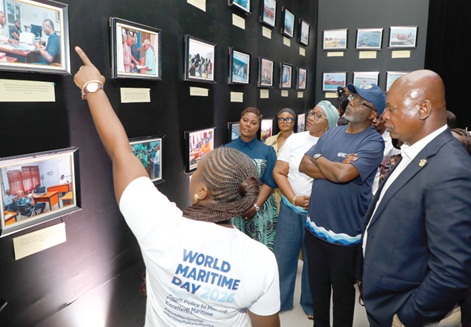
The government is taking steps to translate Ghana’s maritime policies and international commitments into practical interventions to position the country as a leading maritime and logistics hub in West Africa, the Minister of Transport, Joseph Bukari Nikpe, has said.
The measures include the expansion of the Tema Port, the implementation of 24-hour port operations, the transformation of the Takoradi Port into an oil and gas service and bulk cargo hub and the establishment of a hydrographic office to produce navigation maps and charts locally.
Mr Nikpe said the interventions were aimed at harnessing Ghana’s strategic location on the Gulf of Guinea and its maritime resources to create jobs, facilitate trade and generate greater economic value for the country.
He said this when he delivered the keynote address at the 2026 World Maritime Day in Accra last Wednesday, on the theme: “From Policy to Practice: Powering Maritime Excellence.”
Policies into results
The transport minister said the maritime sector was critical to Ghana’s economy, with about 80 to 90 per cent of the country’s international merchandise trade by volume transported by sea.
He said the sector also had the potential to provide opportunities for the youth, adding that the government was, therefore, focused on ensuring that the country derived greater economic benefits from its strategic maritime position.
“The question is not whether Ghana should develop its maritime sector, but how effectively we can translate our policies into greater economic value for our people,” he said.
Mr Nikpe announced that the government was supporting the GMA to establish a hydrographic office in Ghana to enable the country to produce its own navigation maps and charts.
He said Ghana currently depended on external sources for such services, and that developing local capacity would create employment opportunities while strengthening navigation and maritime safety.
Policy to practice
The Director-General of the GMA, Dr Kamal Deen-Ali, said the theme was particularly relevant because Ghana and other maritime nations had adopted several international instruments that must be translated into effective national regulations and services.
He cited the International Convention for the Safety of Life at Sea (SOLAS) and the Standards of Training, Certification and Watchkeeping for Seafarers (STCW) among the key instruments.
Dr Deen-Ali said the GMA had undertaken internal reforms to align its mandates and improve its ability to deliver on its responsibilities.
IMO backs implementation
The Regional Coordinator for the International Maritime Organisation (IMO), Capt. Dallas Laryea, said maritime excellence was not measured solely by the adoption of international conventions but by how effectively countries implemented them.
He said Ghana had demonstrated commitment to strengthening maritime administration, developing seafarers and embracing digital transformation.
Capt. Laryea gave the assurance that the IMO would continue to support Ghana and other countries in the region through technical cooperation, training, advisory services and capacity building.
Ports, digitalisation
The General Manager of Risk Management at the Ghana Ports and Harbours Authority (GPHA), David Songotu, said the Just in Time sailing project was an example of how international maritime policies could be translated into practical action.
Mr Songotu also stressed the importance of digitalisation, cyber security and investment in human capacity to support the future of Ghana’s maritime sector.
Reducing cost, delays
The Deputy Chief Executive Officer of the Ghana Shippers Authority in charge of Technical Services, Asana Dauda Owu, said the practical test of maritime policies was their impact on businesses and cargo owners.
She said delays in cargo clearance and the cost of moving goods through the ports affected inventory, cash flow, prices and the competitiveness of Ghana’s ports.
“If the policy looks good on paper, but the cargo is still waiting, then clearly we have some more work to do,” she said.
