
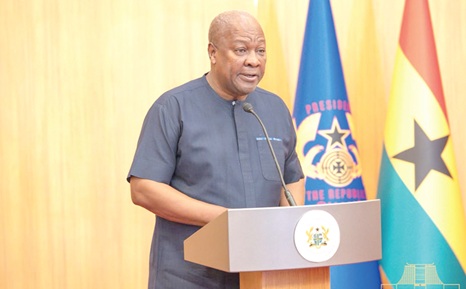
President John Dramani Mahama has announced plans to invest $10 billion in nine priority sectors of the economy over five years under the government’s New Economy Policy.
The new policy is aimed at creating employment opportunities for young people and providing alternatives to illegal mining, popularly known as galamsey.
The priority sectors include tourism, textiles and garments, agriculture and agribusiness, pharmaceuticals and oil palm production.
The President, speaking at the Jubilee House last week, explained that the government intended to allocate approximately $2 billion annually to the selected sectors over the five-year period to stimulate economic activity, attract private investment and expand employment opportunities.
“I believe that if we invest $10 billion in job-rich sectors of the economy, including tourism, one of the nine pillars, it should provide alternative livelihoods for our young people and discourage them from going into galamsey,” he said.
Manufacturing hub
President Mahama said the country was positioning itself to become a pharmaceutical manufacturing hub for West Africa and the continent as a whole.
He said some investors had already expressed interest in establishing facilities in the proposed pharmaceutical hub for which land had been acquired and supporting infrastructure, including roads, electricity and water, has been provided.
The President said during a visit to New York, he met with representatives of a company expected to visit Ghana next month to assess the prospects for investing in the hub.
At the African Union Summit in Egypt, he also held discussions with a major African pharmaceutical company that produces vaccines and medicines and exports to Europe, which had also expressed interest in establishing a facility in Ghana.
Oil palm, rubber production
On agriculture, President Mahama said the government planned to establish 100,000 hectares of oil palm plantations as part of efforts to expand production and create livelihoods.
He urged traditional authorities to take advantage of the initiative by acquiring seedlings and establishing their own plantations, as oil palm production could provide them with a regular source of income.
“You can also get the seedlings and plant them yourselves. Nothing stops Nananom from having 100 acres of oil palm. That will bring you regular income all the time,” he said.
He further announced plans to promote rubber cultivation on farms where cocoa production was no longer sustainable, with the Western North Region identified as one of the areas targeted for increased production.
On cocoa, the President said the Ghana Cocoa Board Act, 2026, now guaranteed farmers 70 per cent of the world market price. Previously, it was just a policy and farmers sometimes received as little as 35 per cent of the free on board (FoB) value of the cash crop.
The President said because the Act had come into operation and the international cocoa price had increased, the government was paying farmers 71.18 per cent, higher than the guaranteed 70 per cent.
That, he said, followed consultations with Côte d’Ivoire although the price differential had widened considerably.
Private sector financing
President Mahama acknowledged that although the macroeconomy had stabilised and interest rates had declined, the creation of jobs would take time.
He said the reduction in interest rates was expected to make borrowing more affordable for businesses and enable them to expand operations and employ more people.
He said the government’s reduced reliance on domestic borrowing had also created room for the private sector to access credit from commercial banks.
“One of the interesting things happening is that the government has stopped crowding out the private sector.
Before, all the banks used to lend to the government because the government had a huge appetite for borrowing,” President Mahama said.
He said the government was now financing its expenditure from tax revenues and other resources accruing to the national treasury rather than borrowing from banks or international credit markets.
President Mahama said banks could now lend to private companies at rates of about 13 per cent, and that allowed businesses to invest, expand production and create jobs.
