
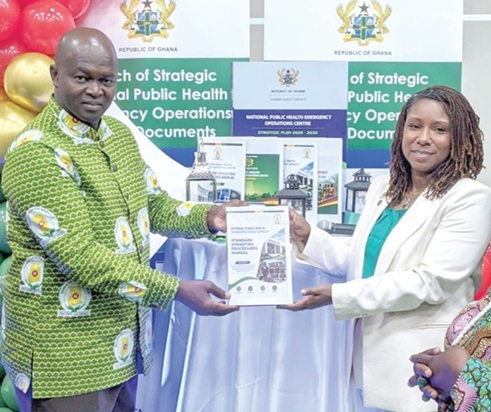
The Ghana Health Service (GHS) has launched five strategic documents and a national roadmap to guide the operationalisation of Public Health Emergency Operations Centres (PHEOCs) across the country as part of efforts to strengthen Ghana’s preparedness and response to public health emergencies.
The framework is designed to establish a functional, connected and standardised emergency coordination system linking the national, regional and district levels, with institutions working together to detect threats early, share information and coordinate timely action.
It provides a common approach to managing infectious disease outbreaks, floods, chemical and radiological incidents, as well as emergencies at points of entry and other events that could threaten public health, national security, communities and the economy.
The initiative is also intended to move Ghana from preparedness based largely on plans and structures to continuous readiness, with emphasis on incident management, public health intelligence, workforce surge capacity, logistics, information sharing and sustainable financing.
The five documents launched are the National PHEOC Strategic Plan 2026–2030, National PHEOC Handbook 2026, National PHEOC Standard Operating Procedures (SOPs) Volume One, National Health Workforce Surge Strategic Plan 2026 and National Public Health Workforce Surge Management SOP Volume Two.
Plans, action
At the launch in Accra last Thursday, the Director-General of the GHS, Dr Samuel Kaba Akoriyea, said the PHEOC system would serve as a platform for bringing together the mandates, capabilities, information and resources of different institutions to support coordinated emergency action.
He said the system would also support implementation of the International Health Regulations (2005), address priority recommendations and capacity gaps identified through the Joint External Evaluation and advance Ghana’s wider health security agenda.
Dr Akoriyea said experiences from outbreaks, including meningitis and cholera, as well as the Ebola and COVID-19 pandemics, had demonstrated the need for a coordinated system capable of responding to emergencies without institutions operating in silos.
National effort
For his part, the Head of the Disease Control Department of the GHS, Dr Kwame Amponsa-Achiano, said the launch was not the end of the process, but the beginning of implementation, with the GHS committed to working with national and sub-national institutions to translate the documents into sustained operational capacity.
He also expressed appreciation to partners, including the United States Centres for Disease Control and Prevention (US CDC), the World Health Organisation, Korea International Cooperation Agency, Africa Centres for Disease Control and Prevention, African Field Epidemiology Network, Palladium Group and International Organisation for Migration.
Implementation plan
The Head of the National Public Health Emergency Operations Centre, Dr Lawrence Lartey, said implementation would focus on seven areas: governance and institutionalisation; ICT and public health intelligence; logistics and infrastructure; emergency operations and incident management; workforce capacity; sustainability and multisectoral coordination; and policies, plans and SOPs.
The strategy, he said, was estimated at GH¢35.4 million over a period of five years.
Dr Lartey said the national PHEOC would connect with regional centres and district-level operations to create one system for coordination, situational awareness, decision-making, resource mobilisation, detection, investigation and response.
He said the roadmap would replace variable arrangements with common national standards and adhoc activation with defined activation, escalation, de-escalation and deactivation procedures.
It would also strengthen shared situational awareness, introduce managed workforce surge arrangements and shift the focus from infrastructure alone to functional operational capability.
Regular exercises, supportive supervision, monitoring and after-action reviews would be used to identify gaps and improve the system.
US CDC partnership
The launch also featured a farewell ceremony for Dr Danielle Barradas, Country Director of the US Centre for Disease Control and Prevention (US CDC) in Ghana, at the end of her tenure.
Dr Akoriyea and Dr Amponsa-Achiano commended her contribution to the partnership between the US CDC, Government of Ghana, Ministry of Health and GHS, particularly in disease surveillance, laboratory systems, workforce development, emergency preparedness and response, PHEOCs, and point-of-entry and border health.
The GHS expressed the hope that the partnership would continue to strengthen as Ghana moves from the launch of the documents to full implementation of the national PHEOC system.
