
The Ghana Extractive Industries Transparency Initiative (GHEITI) has identified significant gaps in mineral royalty distribution, discrepancies in the State's equity participation in mining companies and weaknesses in revenue accountability.
The findings, contained in the 2023 GHEITI Mining Sector Report, highlight weaknesses in mineral revenue management and the need for stronger oversight as the Upper East Region emerges as a new frontier for large-scale mining.
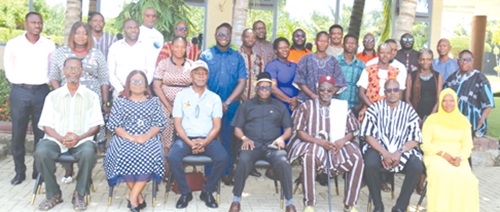
The findings were presented by Fadil Iddi, an Economics and Technical Officer at GHEITI, at a dissemination workshop in Bolgatanga.
The Co-Chair of GHEITI, Dr Steve Manteaw, said the findings offered important lessons for the Upper East Region as communities prepared to benefit from mining operations, including the Cardinal Namdini Gold Mine in the Talensi District.
He said established mining communities had not always translated mineral wealth into lasting development, making transparency, accountability and prudent revenue management essential.
He cited instances where mineral revenue allocations had been used for purposes other than long-term development.
“In some districts, such as Mpohor Wassa East, their share of the revenue allocation was used to attend a funeral, while the Amansie West District used part of its allocation to evacuate refuse dumps,” he said.
He stressed that mineral revenues should finance projects that would benefit future generations, particularly because mineral resources were exhaustible.
The report found that none of the district assemblies covered by the assessment received the appropriate mineral royalty allocations under the prescribed disbursement formula, despite the regional offices of the Office of the Administrator of Stool Lands (OASL) correctly calculating the amounts due.
It also identified discrepancies in ground rent disbursements involving Newmont Ghana Gold Ltd, Adamus Resources, Golden Star Wassa Ltd and Gold Fields Ghana Ltd, and recommended that GHEITI engage the OASL to investigate the issues.
Equity
The report further identified variations in the State's equity participation in mining companies.
Although Section 43(1) of the Minerals and Mining Act, 2006 (Act 703), provides for a 10 per cent free-carried interest for the State in mining leases, the government held only four per cent in AngloGold Ashanti Limited and AngloGold Iduapriem Limited.
It had no equity interest in Newmont Ghana's Ahafo and Akyem operations, while its stake in the Ghana Bauxite Company stood at 20 per cent.
The report recommended considering a minimum carried interest to provide flexibility in negotiations while protecting the State's participation. It said the State accrued approximately GH¢139.6 million in dividends during the reporting period.
It also identified the absence of an effective gold traceability system as an obstacle to allocating royalties to beneficiary districts.
Declining oil production
Beyond mining, the report highlighted declining crude oil production, which fell from 71 million barrels in 2019 to 48 million barrels in 2023, marking four consecutive years of decline.
Dr Manteaw attributed the challenges partly to inadequate exploration investment, regulatory uncertainties and project delays. He called for improved geological data and a predictable fiscal regime to attract investment.
The report also raised concerns about mineral revenue management, including inadequate safeguards for monitoring the 78 per cent of revenues transferred to the Ministry of Finance following the 2025 amendments.
It recommended stronger governance, improved GoldBod disclosures and a national dialogue on mineral revenue management.
The Upper East Regional Minister, Donatus Akamugri Atanga, said the region had developed a framework, Prosperity Through Enterprise, Agriculture Resilience and Livelihoods (PEARL), to build a sustainable alternative economy beyond mining.
He said technical experts were also preparing proposals to review mining laws to ensure that mining communities benefited more from mineral revenues.
