
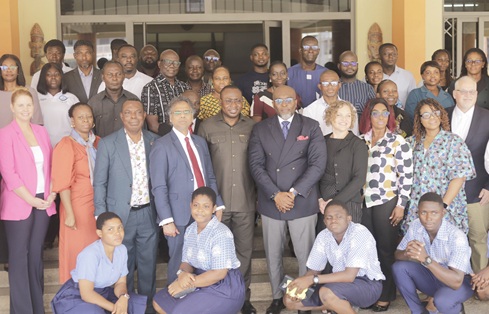
Ghana and the United States are planning a technical and vocational education partnership to equip Ghanaian youth with industry-ready skills to improve their employment prospects.
The partnership seeks to bridge the gap between classroom training and industry requirements by equipping learners with practical skills, strengthening instructors’ capacity and aligning technical education with the needs of employers.
Led by the Ghana TVET Service and Hilltop Global Group, the initiative will bring US community colleges and Ghanaian technical institutions together to develop training programmes tailored to the job market.
Speaking at the launch yesterday,October 20, the Chief Executive Officer of Hilltop Global Group, Phil S. Agbeko, said the partners would assess skills gaps in Ghana’s technical and vocational education and training (TVET) system and develop a pilot programme across selected trade areas.
The proposed collaboration, he said, would focus on instructor training, curriculum development, faculty exchanges, applied research and stronger links between technical institutions and employers.
Partnership
Mr Agbeko said the visiting delegation had expertise in fields including aerospace engineering, software engineering, mechatronics and agricultural technology.
The planned activities include training instructors, facilitating faculty exchanges, reviewing curricula, supporting applied research and using digital tools to strengthen practical learning.
The Deputy Director of Assessment and Quality Assurance at the Ghana TVET Service, Veronica Manu Narterh, who spoke on behalf of the Director-General, Dr Eric Kofi Edzro, welcomed the initiative and called for stronger collaboration between education providers and industry.
She said the partnership would help institutions respond to changing workplace demands and prepare graduates to operate and maintain modern equipment, improve production and establish enterprises.
Ms Narterh urged employers to identify the skills required in their sectors, expose instructors to current industrial practices and provide trainees with practical learning opportunities.
She also called for inclusive training opportunities for women and persons with disabilities, as well as environmentally responsible practices, including efficient resource use, proper waste management and workplace safety.
Workforce
The Executive Director of Community Colleges for International Development (CCID), Karen McBride, said US community colleges provided technical education designed to meet workforce needs.
She explained that students at US community colleges could earn technical certificates or associate degrees and either enter employment or transfer to four-year institutions.
For his part, the Vice-Chancellor of Ho Technical University, Professor Ben Q. Honyenuga, said the institution was ready to contribute its faculty, facilities and expertise to the proposed partnership.
