
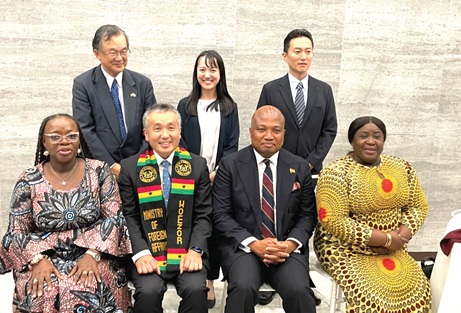
Ghana will soon establish its first space institution with the support of the Japanese government to advance aerospace technology and scientific research, the Minister of Foreign Affairs, Samuel Okudzeto Ablakwa, has said.
Mr Ablakwa said a policy will soon be presented to Cabinet for the establishment of the institution, adding that Ghana had already signed strategic Memoranda of Understanding (MoUs) with Japan at both governmental and institutional levels, including with the University of Ghana.
The minister was speaking at a dinner hosted in honour of Japanese astronaut and Chief Technology Officer for Asia Pacific, Axiom Space, Koichi Wakata, at the Ministry in Accra.
He said the partnership reflected the country’s determination to aspire to greatness, citing Japan’s rise to become one of the top three countries with the highest number of space missions after the United States and Russia.
Mr Ablakwa said Japan had consistently supported Ghana’s development, from science and infrastructure to maritime security and job creation, describing the relationship as a win-win.
He said the country was inspired by the story of Mr Wakata, who has travelled to space multiple times, stressing that his journey was an epitome of possibility and perseverance.
He disclosed that next year Ghana and Japan would mark three milestones: the 70th anniversary of formal bilateral relations, 50 years since the arrival of the first Japanese volunteers and 100 years since the arrival of Dr Hideyo Noguchi in Ghana.
The minister commended the Vice-Chancellor of the University of Ghana, Professor Nana Aba Appiah Amfo, who was also present at the dinner, for maintaining the university’s reputation as a global centre of excellence and for driving innovation and research.
He conveyed greetings from President John Dramani Mahama, who he said was grateful to Japan for giving him his first international opportunity as a young professional.
Experience
For his part, the Japanese astronaut recounted how watching the Apollo moon landing at age five inspired him, even though Japan had no space programme or rockets at the time.
“As a small boy in Japan, I thought it was beyond my reach to work in space and fly in space. But thanks to international collaboration, I was able to join talented people from all over the world,” he said.
Mr Wakata, who has flown in space multiple times and spent more than six months in orbit, said astronauts circle the Earth every 90 minutes, experiencing 16 sunrises a day.
He said while his flight from Japan to Ghana took about 20 hours, the same distance could be covered in 20 minutes by spacecraft.
Potential
The Ambassador of Japan to Ghana, Hiroshi Yoshimoto, described Ghana’s space programme as a growing young child with huge potential.
He said Japan launched its first satellite about 10 years ago from the Tsukuba Space Centre in Japan, where Mr Wakata once worked.
“You said Ghana’s space programme is like a baby.
I would say not a baby, it is a young child,” he told the Minister of Foreign Affairs.
Mr Yoshimoto described Mr Wakata as a legend in Japan and in the global space community, stressing his five space flights, 504 days in space and his role as the first Japanese commander of the International Space Station in 2014.
The Ambassador said Mr Wakata’s visit had laid a good foundation for next year’s 70th anniversary of Ghana-Japan relations and would help strengthen cooperation beyond infrastructure and health into science and technology.
