
Ghana is set to receive $68 million in carbon credits for 6.5 million tonnes of verified emissions reduction under the REDD+ Environmental Excellence Standard (TREES).
The initial $43 million payment is expected to hit the nation’s account by January next year, per expert analysis.
The country achieved the feat under the Architecture for REDD+ Transactions (ART), a global initiative that seeks to incentivise governments to reduce emissions from deforestation and forest degradation (REDD), for emission reductions in the forest sector covering the period 2017 to 2021.
The TREES is a global standard developed by the ART to quantify, monitor, report and verify greenhouse gas (GHG) emission reductions and removals from forest protection and restoration at national or subnational scales.
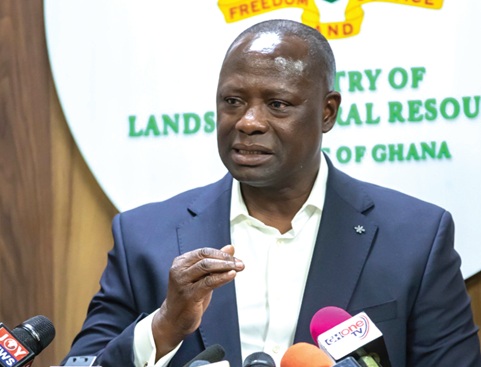
The Minister of Lands and Natural Resources, Emmanuel Armah-Kofi Buah, made this known at a media briefing in Accra last Monday, stating that the feat had made Ghana the first country in Africa and third in the world to be issued carbon credits under TREES.
He explained that following the issuance of 6.5 million tonnes of carbon credits by ART, international buyers, including the Lowering Emissions by Accelerating Forest Finance (LEAF) Coalition, had already committed to the initial payment of about $43 million.
“These payments are expected to cover the purchase of about four million tonnes of verified emission reductions, represented by ART TREES credits, at prices ranging from $10 to $13 per tonne,” he said.
Mr Buah said the milestone was historic and underscored the great work the Forestry Commission had put in to manage the country's forest resources, even under resource constraints.
"This journey started with REDD+ since 2008, and we give credit to successive governments. We are very proud of this achievement, and we will continue to support the Commission to achieve more laurels," he added.
Details
Throwing more light on the milestone, the Chief Executive of the Forestry Commission, Dr Hugh C.A. Brown, said the remaining 2.5 million tonnes of carbon dioxide equivalent valued at $25 million presented further sales opportunities, with the potential to mobilise additional financing to support forest protection, reforestation, sustainable land management practices and improved livelihoods for forest-dependent communities across the country.
Dr Brown explained that ART approved Ghana's TREES concept in 2021, and then in January 2024 it accepted the registration document and monitoring report for the 2017-2021 crediting period.
He said the validation process included assessment of Ghana's forest data and accounting methodologies, safeguards implementation and compliance with TREES requirements.
Dr Brown acknowledged the contributions of farmers, forest-fringe communities, traditional authorities, successive ministers, boards and management of the Forestry Commission, and the technical teams whose sustained work made this issuance possible.
He added that the historic issuance of the carbon credit was a strong affirmation of Ghana's commitment to protecting forests while pursuing climate-resilient development.
Again, he said, it had demonstrated that high-integrity climate action could mobilise meaningful finance for forest protection while supporting farmers, communities and traditional authorities whose efforts remained central to sustaining forest landscapes.
Sustainability
For his part, the acting Director of the Climate Change Unit at the Forestry Commission, Dr Joseph Appiah-Gyapong, said the results-based climate finance required that the country must demonstrate measurable results before payments could flow.
He added that future payments depended on Ghana keeping deforestation low by addressing challenges such as wildfires, expansionist farming practices, illegal mining and logging, all of which put pressure on forests.
“The next monitoring period, covering 2022 - 2026, will need to show that results are maintained or improved,” he said, adding that “sustaining the progress will require continued collaboration among government, forest-fringe communities, traditional authorities, civil society, development partners and carbon-market buyers, alongside continued investment in forest protection, monitoring and sustainable livelihoods.”
Context
Ghana began preparing for REDD+ in 2008 through sustained investment in forest monitoring, safeguards and benefit-sharing arrangements, as well as landscape-level implementation.
Across participating landscapes, farmers, communities and traditional authorities have supported sustainable land use practices, while government institutions have maintained the monitoring, safeguards and implementation systems required to demonstrate credible emission reductions.
The country has already demonstrated how forest protection and reforestation programmes can generate carbon payments.
Under the Ghana Cocoa Forest REDD+ Programme (GCFRP), supported by the Forest Carbon Partnership Facility (FCPF), Ghana has so far received $21.8 million between 2023 and 2024.
Distributed through benefit-sharing arrangements, the funds have supported forest protection and landscape restoration, provided farming inputs, boreholes, Community-Based Health Planning and Services (CHPS) compounds, school blocks and school furniture.
