
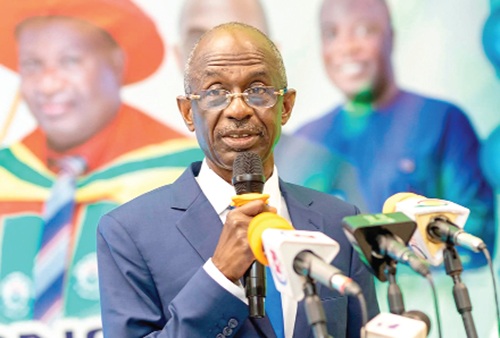
The National Chairman of the National Democratic Congress (NDC), Johnson Asiedu Nketiah, has called for greater foresight in national development to enable the country to anticipate emerging challenges and plan for them before they become crises.
He explained that the country was already aware of the major pressures it would face in the years ahead, including rapid population growth, expanding towns and cities, and increasing demand for energy, transport, housing and public services, alongside changing skills requirements.
Mr Nketiah was speaking at the fourth Bono Regional Ghana Journalists Association (GJA) Awards at Abesim near Sunyani in the Bono Region last Saturday.
National planning
Mr Nketiah called for greater foresight in national planning, urging the government to invest ahead of emerging needs rather than wait until shortages and other challenges become more costly to address.
“We have become quite good in Ghana at solving problems after they have become expensive.
We should become equally good at dealing with some of them while they are still manageable,” he said.
He said setting aside land for industry before it became scarce, developing the requisite skills ahead of demand and investing in infrastructure before shortages turned into crises were practical measures that could shape the country’s development.
Mr Nketiah also called for stronger links between agriculture, processing, storage, logistics and markets, saying infrastructure development should be accompanied by plans to ensure that communities derived greater economic value from their resources.
Continuity of projects
The NDC’s national chairman said Ghana should develop a culture of continuity in public projects, and argued that governments should preserve programmes that were working rather than abandon them simply because they were initiated by previous administrations.
He said although governments had the right to discontinue policies that were failing, programmes that were delivering results should instead be improved so the country could reap the benefits of its investment.
“A country cannot start every four years afresh,” he said.
Limited resources
The Minister for Works, Housing and Water Resources, Ahmed Ibrahim, commended Bono regional journalists for maintaining professional standards despite limited resources.
He recalled that during the 2020 election period, when political tensions were high, the journalists became a “light” in places where they believed their presence was needed.
Mr Ibrahim, who is also the Member of Parliament (MP) for Banda, recalled an instance in which some journalists hired a taxi for two weeks to patrol the borders of the Bono Region, travelling from Sunyani to other parts of the region to monitor developments.
He said the journalists lacked not only an office but also adequate means of transportation, with some reportedly involved in an accident while returning from the northern part of the region, while others had fallen victim to armed robbers.
Mr Ibrahim said despite the challenges, the journalists remained committed to their duties, describing their perseverance as a demonstration of professionalism, ethics and integrity.
The GJA Organising Secretary, Suleiman Mustapha, said the power of journalism came from communities and urged regional journalists to draw attention to issues affecting education, health care, agriculture, local governance, infrastructure, the environment and youth development.
He said impactful journalism should go beyond telling people what had happened to helping society to understand why an issue mattered and, where appropriate, promote public discussion and accountability.
Mr Mustapha, who is also the Editor of the Graphic Business, said journalists contributed to societal transformation when they brought citizens’ concerns to the attention of authorities, exposed issues requiring action and gave communities a voice.
He said social media, citizen journalism and the 24-hour news cycle had transformed how information was produced and consumed, and presented opportunities but also challenges for professional journalism.
Mr Mustapha said artificial intelligence could assist journalists with research, transcription and translation but could not replace their editorial judgement and responsibility for what was published.
He reminded award recipients that journalism was bigger than certificates and awards, saying important stories, investigations and work that gave communities a voice were themselves contributions to society.
Mr Mustapha urged journalists to see professional recognition as an encouragement to strive for higher standards and continue to use journalism to contribute to national development.
Writer's email
