
After decades of being anchored firmly to traditional Western multilateralism, the President John Dramani Mahama-led administration has signaled its biggest foreign policy pivot in a generation.
The Minister of Foreign Affairs, Samuel Okudzeto Ablakwa on Tuesday (October 6, 2026) announced that Cabinet has approved Ghana's bid to join BRICS — the grouping originally formed by Brazil, Russia, India, China and South Africa, and now expanded to include Egypt, Ethiopia, Iran, UAE, Saudi Arabia and Indonesia.
The announcement was the clearest expression yet of President Mahama's "New Economy" doctrine.
Thus, moving from IMF-led stabilisation to transformative, job-rich growth anchored on resource sovereignty and diversified partnerships.
If Ghana succeeds, it would become the fourth African member after South Africa, Egypt and Ethiopia.
This will also lead to a profound implication for the country’s diplomatic image and economic development in the multilateral system.
Strategic options
Ghana's foreign policy since independence has been defined by Dr Kwame Nkrumah's non-alignment.
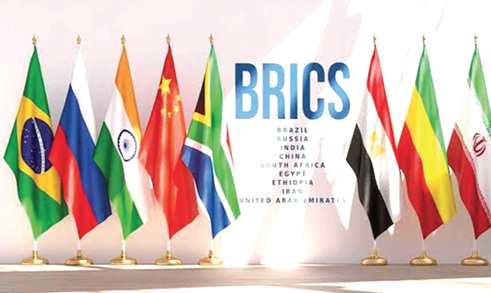
The flags of respective BRICS member countries
In practice, however, Ghana's economic diplomacy has been heavily aligned with the West.
The IMF, World Bank, Paris Club and G20 Common Framework among others.
Joining BRICS could reframe non-alignment as active multi-alignment.
Mr Ablakwa was careful to point out that, "We are not going to walk away from our traditional partners.
We value that relationship, but we must have new friends".
This is strategic hedging.
In a world Mr Ablakwa described as multi-polar, Ghana wants options.
He specifically cited Afreximbank's $700 million intervention during the financial crisis as proof that African multilateral institutions can rescue where traditional lenders attach conditionalities.
Resource sovereignty, conditionality argument
The political heart of President Mahama administration's is resource sovereignty.
The Minister in his explanation stressed that, government wanted something new.
The government is resolute on resource sovereignty, and wants relations where Ghana is treated as equal partner.
“We don't want a situation where we continue to export raw materials and not to be boxed down with conditionalities from a few international institutions," Mr Ablakwa affirmed.
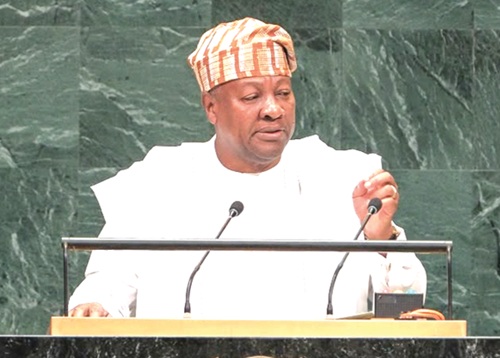
This, resonates with President Mahama’s statement at the 81st UN General Assembly, where he declared that, Africa will not be a “New Scrambles” for critical minerals, and that Africa will process its own minerals.
For a government that campaigned on resetting Ghana's economic model, the optics of negotiating with institutions that "have the same shared history" is powerful domestically.
Diplomatically, however, it may carry risk as Ghana is still in an IMF programme, still negotiating with bilateral creditors, and still reliant on US and EU market access under AGOA and the Interim EPA.
A BRICS bid could be read in Washington and Brussels as drifting.
The success of the bid will depend on how the government of Ghana frames it. “Not as anti-West, but as pro-options”.
This membership could also reshape intra-African dynamics. South Africa has long been seen as Africa's sole voice in BRICS.
Egypt and Ethiopia joined in 2024, adding North and Horn of Africa representation.
Ghana would bring West Africa, ECOWAS, and a strong democratic credential into the bloc.
It would also put Ghana in direct competition with Nigeria, which has also expressed interest but has not yet formally applied.
For Ghana, which has historically punched above its weight diplomatically, BRICS would restore the image of Ghana as a continental thought leader; similar to its early role in the Non-Aligned Movement.
Economic case
The economic case is already visible in the trade numbers Mr Ablakwa cited.
Ghana-India trade has jumped from about $3 billion in 2024 to around $7 billion today.
China is Ghana's largest source of imports and a major creditor and contractor for roads, ports, and energy.
BRICS offers a formal platform to leverage those bilateral ties into systemic benefits: local currency trade settlement, supply chain integration, and industrial co-investment.
For example, 70 per cent of Ghana's pharmaceutical imports come from India.
If BRICS creates a framework for technology transfer for local drug manufacturing — which is the core of President Mahama's health sovereignty agenda launched at the Alamein Africa Forum, that could accelerate import substitution.
Similarly, China and Brazil have expertise in agro-processing and tropical agriculture that directly aligns with Ghana's Feed Ghana programme and its new target of rice self-sufficiency by 2028.
The most tangible economic benefit would be access to the New Development Bank.
The NDB has approved over $32 billion in projects since 2015, with a focus on infrastructure, transport, water and social infrastructure.
For Ghana, which needs $12 billion annually to close its infrastructure gap, NDB lending typically with longer tenors and fewer policy conditionalities could finance the seven pillars of the New Economy without adding to Paris Club debt.
The core economic promise of BRICS for Ghana is captured in one phrase Mr Ablakwa used,"We don't want to continue to export raw materials".
BRICS is a bloc of resource-rich countries that have industrialised. Brazil added value to soy and iron ore.
China added value to rare earths. India added value to generics from raw APIs. Indonesia is now banning raw nickel exports to force local refining.
Ghana, with gold, lithium, bauxite and cocoa, wants to do the same.
The BRICS framework could provide three things; “Markets – the AfCFTA plus BRICS would give Ghana duty-free or preferential access to a market of over 3.5 billion people”; “Technology – joint ventures in bauxite-to-alumina refining with China or Brazil”; and “Bargaining power - collective negotiation for fairer commodity pricing”.
The risk may be that without a strong domestic industrial policy, Ghana simply swaps one form of dependency for another; thus, “exporting raw lithium to China instead of raw gold to Switzerland”.
While, “de-dollarisation, investor perception, and implementation capacity” are three risks to be considered in this bid, in effect, the government’s BRICS bid can be best understood as a calculated diplomatic move that fits President Mahama's broader reset agenda from stabilisation to sovereignty.
