
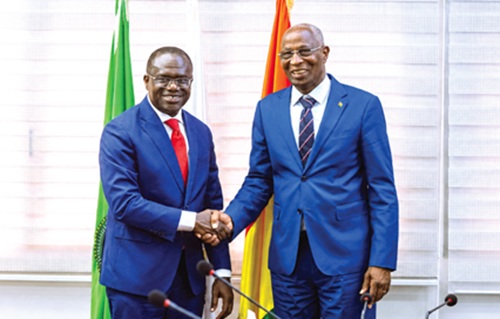
The Prime Minister of Guinea, Amadou Oury Bah, has described the new waste management partnership between Ghana's Jospong Group of Companies (JGC), through its environmental services subsidiary, Zoomlion Ghana Limited, and Guinea as a continuation of the "historic brotherhood" between the two countries.
"The relationship between Ghana and Guinea has been historic, dating back to the days of independence. Our two countries have been friends since then, and this partnership is a continuation of that brotherhood," he said.
The Prime Minister was addressing a delegation from the JGC, led by the Executive Chairman, Joseph Siaw Agyepong, last Tuesday, after signing a landmark public-private partnership agreement with the Government of Guinea in Conakry.
Project
The agreement aims to establish an integrated, modern municipal waste management system for Conakry, moving the city from an unsustainable linear disposal model towards a circular sanitation economy prioritising waste recovery, recycling and resource utilisation.
Operating locally through Zoomlion Guinea Integrated Waste Solutions Limited (ZGIWSL), the company will work closely with the Ministry of Sanitation, Hydraulics and Hydrocarbons (MAHH) and the National Agency for Sanitation and Public Health (ANASP).
Its responsibilities include managing and operating key Zone de Tri et de Transit (ZTT) transfer stations, organising waste collection in major public markets, and overseeing transportation to the Baritodé landfill and future resource-recovery facilities.
Guinea’s challenges
Earlier, Guinea's Minister of Sanitation, Hydraulics and Hydrocarbons, Aboubacar Camara, said Conakry's sanitation sector had reached a major turning point with the signing of the contract, which he said aligned with the vision of President Mamadi Doumbouya and the orientations of the Prime Minister.
For years, he said, Conakry was cleaned, but waste from Manéah and elsewhere was transported and dumped again in the heart of the city.
"We cleaned the city, but afterwards we would gather these piles of trash again in the middle of the city. And that is what motivated the President of the Republic to ask us to close Dar-es-Salam in the first place."
He explained that the second phase, coordinated by the Prime Minister, was to find solutions to definitively end catastrophic waste management.
He said Guinea had worked with Jospong for years, describing the group as operating in 29 countries with enormous experience in waste management, recovery and transformation.
After initial due diligence, Guinean teams travelled to Ghana several times, he said.
He said following negotiations and a follow-up visit, the parties finalised the contracts, binding the ministry and the communes of Conakry.
"Today, we can announce that the question of sanitation at the level of Conakry is meeting a major turning point in a decisive stage, namely the modernisation, the transformation, but also the industrialisation of our waste," Mr Camara noted.
Indigenous solutions
Mr Agyepong commended President Doumbouya for his vision and commitment to transforming Guinea's development landscape.
He stressed the need for African countries to move beyond traditional financing and operational arrangements that have often failed to deliver sustainable solutions.
"For over 30 years in Africa, governments have depended almost exclusively on World Bank and IMF frameworks to solve urban sanitation problems, which has repeatedly proven unsustainable over time," he said.
"What we are bringing to Guinea is a self-sustaining, circular industrial model built on localised African capacity.
We are proud to buy into President Doumbouya's Simandou 2040 vision, turning urban environmental challenges into drivers of economic growth, public safety and job creation."
He outlined the group's capacity — operations in 29 countries, an asset base exceeding $2.4 billion, approximately 10,000 employees globally, and a research and technical pool of more than 200 PhD holders specialising in waste engineering and related fields (figures provided by the company).
Mr Agyepong gave an assurance that machinery and equipment deployed in Conakry would be purpose-built to meet local operational requirements rather than standard imports — a principle he described as “exactly tailored to our own needs".
