
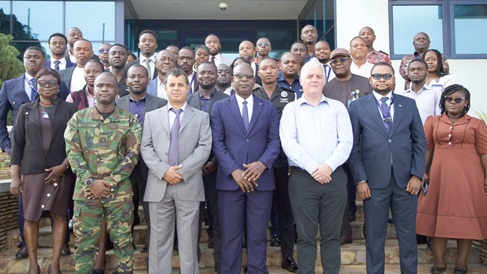
A week-long training programme has been opened in Accra to build the capacity of aircraft accident investigators and aviation safety professionals to conduct effective and internationally compliant investigations.
It is expected to position the country as a regional leader in aircraft accident investigations and strengthen its preparedness to handle the anticipated growth in air traffic as Ghana seeks to become an aviation hub in West Africa.
The training, organised by the Aircraft Accident and Incident Investigating and Prevention Bureau (AIB Ghana) in collaboration with Cranfield University in the United Kingdom, is aimed at sharpening the investigative skills and technical competencies of participants.
The trainees were selected from AIB Ghana, Ghana Air Force, Ghana Navy, Ghana Armed Forces, Ghana Police Service, Ghana Civil Aviation Authority, Ghana Airports Company Limited, airline operators and ground handlers.
Strengthen capacity
Opening the aircraft accident investigation training programme in Accra yesterday, the Commissioner of AIB Ghana, John Wumborti, stated that the training formed part of efforts to strengthen the country's capacity to respond effectively to the increasing demands of the aviation industry.
He said Ghana's ambition to become an aviation hub would result in increased air traffic, requiring stronger institutional capacity and more rigorous efforts to maintain airspace safety.
Mr Wumborti stated that the training was intended to prepare investigators and other aviation professionals for the anticipated growth while ensuring that the country's investigative capabilities met International Civil Aviation Organisation (ICAO) standards.
He explained that Cranfield University was an ICAO-accredited institution with considerable expertise in aircraft accident investigation and aviation safety training.
He added that it was the second time AIB Ghana had engaged the university for such a programme.
Collaboration
Mr Wumborti stated that the involvement of the various institutions was to promote collaboration and ensure that personnel understood their respective roles in supporting accident investigations and improving aviation safety.
He said the programme would equip participants with practical skills in investigation procedures, evidence management, hazard and risk assessment, investigative interviewing, analysis, safety recommendations and report writing.
He added that the practical sessions, group activities and simulated investigations would enable participants to apply their knowledge to real-life investigative situations.
Regional cooperation
A facilitator from Cranfield University, Jeremy Turner, said effective aircraft accident investigations required collaboration among countries, particularly where incidents involved multiple jurisdictions.
He explained that investigators must be able to work across borders and independently, while ensuring that evidence was properly preserved and investigations translated into meaningful safety recommendations.
Mr Turner said the training would equip participants with the skills to handle both minor incidents and major accidents.
He stressed that the initial priority in any accident was the preservation of life, followed by recovery and investigation to prevent future occurrences.
He expressed the university's commitment to sustaining its partnership with AIB Ghana through further training programmes.
