
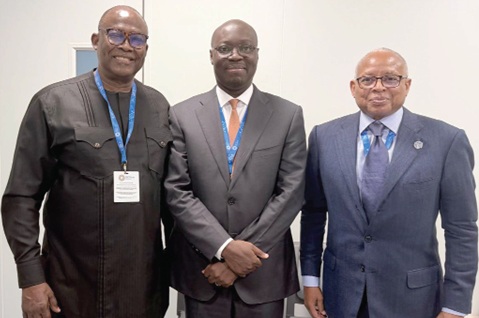
Ghana is developing a reparations financing framework intended to provide a structured mechanism for addressing the economic and social damage caused by slavery and colonialism.
The Presidential Special Envoy for Reparations, Ekwow Spio-Garbrah, said his office had prepared a draft paper on reparational finance for consideration by relevant government institutions, including the Presidency and the Ministries of Finance and Foreign Affairs.
He explained that the proposal would undergo further consultations and expert reviews before it could be presented to the international community for support.
Speaking to media personalities from Ghana on the sidelines of the annual meetings of the International Monetary Fund (IMF)/World Bank at Bangkok in Thailand last Saturday, Mr Spio-Garbrah said the initiative was expected to contribute to the broader African Union agenda for reparatory justice, including the proposed establishment of a global reparations fund.
“Ghana is developing a framework for reparations financing that could provide an institutional basis for mobilising resources to address the historical damage caused by slavery and colonialism.”
“We hope that, once validated and adopted by the relevant authorities, the framework will contribute to global discussions on reparations financing and support efforts towards the establishment of a global reparations fund," he said.
Background
Ghana has intensified efforts to advance the African reparations agenda, with President John Dramani Mahama serving as the African Union (AU) Champion on Reparations to promote calls for redress for the historical injustices of slavery and colonialism.
The initiative seeks to address the lasting economic, cultural and social consequences of the transatlantic slave trade and colonial rule across Africa and its diaspora.
The AU has also advocated the establishment of a global reparations fund to mobilise resources for reparatory justice.
Mr Ekwow Spio-Garbrah’s presence at the annual meetings in Bangkok, Thailand, is part of efforts to explore how the global financial institutions and the wider international community could support discussions on reparations financing, although formal engagement on the agenda with the institutions is yet to begin.
Expert review
Mr Spio-Garbrah said the draft paper, titled Reparational Finance, was intended to establish an institutional framework through which governments and other stakeholders could mobilise resources to address the economic consequences of slavery and colonialism.
He said the document would first undergo consultations with relevant government institutions and experts in finance before being considered for wider adoption.
He added that the initiative could require legislation to establish a statutory national reparations body with a clear mandate, accountability mechanisms and the capacity to report its activities to Parliament.
Global reparations fund
The Special Envoy said the proposal was part of Ghana’s efforts to respond to the African Union’s call for the establishment of a global reparations fund to support reparatory justice.
He explained that the proposed framework was intended for a global audience and could provide a basis for bilateral and multilateral contributions from countries and institutions willing to support reparations.
Mr Spio-Garbrah said the initiative would require sustained engagement with African countries and the international community to build consensus on its principles and operational arrangements.
He stressed that reparations went beyond financial compensation to include addressing cultural and institutional damage, restoring looted artefacts and rebuilding economies weakened by centuries of exploitation.
Beyond financial compensation
He cited Germany’s commitment to provide €1.1 billion in support related to atrocities committed against Namibia’s Herero people as an example of efforts to address historical injustices.
He said Ghana’s approach would also consider the specific historical experiences of communities within the country, including claims relating to the loss of human lives, property and cultural artefacts.
Mr Spio-Garbrah said his office had also prepared a draft five-year programme of action, which was awaiting further consideration and approval by the relevant authorities, explaining that the success of the initiative would depend on securing the necessary institutional support, approving its proposed programmes and establishing a sustainable framework capable of attracting international backing.
