
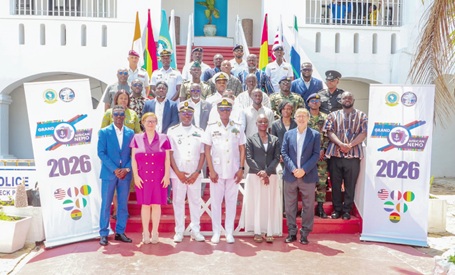
Ghana and Côte d’Ivoire are to test their capacity in coordinating responses to large-scale oil spills across their shared maritime boundary during the 2026 edition of Exercise Grand African NEMO (GANO), a multinational maritime security exercise in the Gulf of Guinea.
The exercise is an annual multinational maritime security programme aimed at strengthening regional cooperation and enhancing maritime safety and security across West and Central African coastal states.
Participating countries are Ghana, Côte d’Ivoire, Guinea, Liberia and Sierra Leone.
Launched by the Multinational Maritime Coordination Centre (MMCC) Zone ‘F’ at the Osu Castle in Accra on October 28, 2026, the exercise would assess Ghana and Côte d’Ivoire's operational readiness, bilateral coordination and legal frameworks for responding to transboundary marine pollution incidents.
The exercise forms part of wider regional efforts under a Yaoundé Architecture to strengthen maritime security cooperation and protect the Gulf of Guinea against transnational maritime threats.
Significance
The Chief of Naval Staff of the Ghana Navy, Rear Admiral Godwin Livinus Bessing, described the scenario as a significant step towards strengthening bilateral cooperation in responding to marine pollution.
He commended stakeholders in both countries for agreeing to participate, saying the exercise would test operational procedures, improve interoperability and build confidence among participating forces.
Rear Admiral Bessing said no single country could effectively secure its maritime domain, underscoring the importance of intelligence sharing, joint patrols, coordinated responses and sustained capacity-building.
Livelihoods
The Ambassador of France to Ghana, Diarra Dimé-Labille, said maritime security was fundamental to protecting livelihoods, food security and economic activities across the Gulf of Guinea.
She said nearly one in 10 people in Ghana depended on fishing activities, with more than two million people engaged in small-scale fisheries.
The ambassador said illegal fishing, piracy and oil spills threatened coastal livelihoods and the food security of the wider region, making cooperation among maritime nations essential.
Mrs Dimé-Labille said 19 African navies and nine partner navies would participate in this year’s exercise, involving 60 vessels and 10 aircraft.
It would include the French amphibious assault ship Mistral and the Ghana Navy ship MV Esther Ocloo.
She said the forces would train across a range of maritime security operations, including combating illegal, unreported and unregulated fishing, piracy, armed robbery at sea, trafficking, search and rescue, and marine pollution response.
On the oil-spill scenario, the ambassador said the exercise would deploy air and naval assets through a coordinated operational sequence, beginning with reconnaissance and assessment of pollution, progressing to intervention and containment.
The objective, she explained, was to enable navies, coordination centres and other agencies to operate as a unified chain, from detecting and assessing maritime incidents to interception and containment.
She acknowledged all partners, including the EU, Italy, Spain, Portugal, Belgium, Denmark, the US, Morocco and Mauritania.
The Director of MMCC Zone ‘F’, Captain Daniel Ehu, reaffirmed the centre’s commitment to promote cooperation among navies, coast guards and maritime institutions.
