
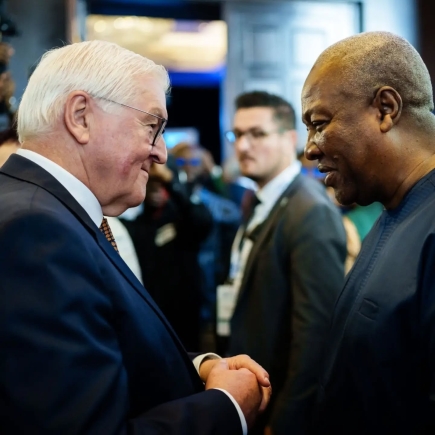
German Federal President Frank-Walter Steinmeier has declared that Africa and Europe need each other now more than ever, urging German businesses to be “curious, take risks and invest in our common future”.
At the opening of the sixth German-African Business Summit in Accra yesterday, President Steinmeier said the geopolitical ruptures of the time had undermined the certainty of traditional German export markets, making Africa the new horizon for investment.
“Africa and Europe need each other. In today’s world, that sentence contains a new urgency,” he told a gathering of business leaders, experts and political figures from Germany and Africa.
The summit brings together senior business executives, policymakers, investors, and industry leaders from across Germany and Africa, and serves as the premier platform for advancing trade, investment, and industrial cooperation between both regions.
The German leader, on his final official visit to Ghana before his tenure ends in March 2027, co-opened the summit with Ghana’s President, John Dramani Mahama.
He noted that trade between African countries and Germany rose about 10 per cent last year to a new record, but stressed that much dormant potential remained untapped.
“If I may make a wish at this last German-African Business Summit that I will attend in my official capacity, I would urge the German business sector to make use of the opportunities in the African countries, be curious, take risks and invest in our common future,” President Steinmeier said.
New horizons
The German President observed that for a long time, many German companies had relied on secure revenue from major export markets in North America and China, but geopolitical ruptures had undermined that certainty.
“It is time for new horizons, time to take a closer look at economic opportunities still waiting for us here in Africa,” he said.
He also called on African countries not to waver in implementing reforms to facilitate trade and open new trade routes, describing the African Continental Free Trade Area (AfCFTA) as the largest of its kind in the world, and a crucial step towards growth and prosperity.
President Steinmeier further called for reform of international organisations, especially the United Nations, to give a stronger voice to African countries.
“It is high time that we ensured in the international organisations, first and foremost in the United Nations, that this order does justice to today’s world. That includes a strong voice for the countries of Africa,” he said.
Economic reforms
In his address, President Mahama threw light on the New Economy Programme, under which the government intends to spend $10 billion across four years, from 2027 to 2030, in partnership with the private sector, including German investors.
The programme focuses on agriculture, agro-processing, manufacturing, energy, infrastructure, pharmaceuticals, tourism and the creative industry, digital innovation and mineral beneficiation.
“We must process what we produce, we must manufacture what we consume, and compete effectively in regional and global markets,” President Mahama said.
He said the New Economy agenda, supported by the 24-Hour Economy initiative, was designed to add value to Ghana’s exports, create jobs locally, and integrate Ghanaian enterprises into regional and international value chains.
The President presented a strong economic scorecard, noting that Ghana’s GDP had surpassed the $100 billion mark, making it the eighth largest economy in Africa and the second largest in West Africa.
He said the economy grew by 6.0 per cent in 2025, inflation had declined from 23.8 per cent in December 2024 to 5.2 per cent as of September 2026, while international reserves had risen from $8.9 billion to about $12.94 billion.
He also disclosed that Ghana’s exports to the European Union rose by 23.2 per cent in 2025, resulting in a trade surplus of €418 million in Ghana’s favour.
KFW factory success
President Mahama commended KFW, Germany’s development bank, for financing the North Shore Apparel Factory in Savelugo in the Northern Region, which now employs more than 2,000 young people, 80 per cent of them female.
“Today, 2,000 of them have remained at home because they can find opportunity in the northern part of our country,” he said.
He invited German companies to consider Ghana as a strategic entry point into the African market under the AfCFTA, whose secretariat is hosted in Accra.
Local production
The Minister of Trade, Agribusiness and Industry, Elizabeth Ofosu-Adjare, said Ghana intended to move beyond exporting raw materials and food products to Germany by strengthening local production capacity and improving the competitiveness of Ghanaian businesses.
She said there was significant scope to expand bilateral trade through value addition, manufacturing and the development of local industries.
“We value this trade, but we see room for much more, particularly in processing, manufacturing and the technical skills that enable local enterprises to supply demanding markets,” she said.
