
The Ministry for Gender, Children and Social Protection has expanded social protection coverage and increased cash grants for vulnerable households, while strengthening the legal framework to protect the rights of women, children, and persons who are challenged.
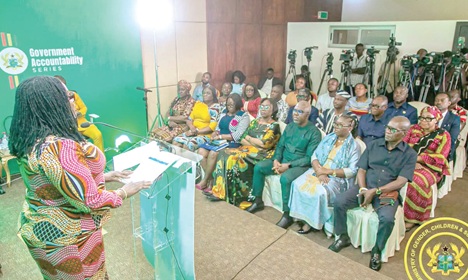
Presenting the ministry’s progress at a Government Accountability Series in Accra last Wednesday, the sector Minister, Dr Agnes Naa Momo Lartey, said the government had begun disbursing the first and second payment cycles of the Livelihood Empowerment Against Poverty (LEAP) programme for 2026, with a substantial increase in grant amounts.
Under the new structure, a household with a vulnerable member would receive between GH¢392 and GH¢630 bi-monthly, while those without vulnerable persons would receive between GH¢380 and GH¢594.
The ministry has also expanded the LEAP ceiling from 350,000 to 450,000 households, with over 226,000 households graduating out of extreme poverty following a comprehensive reassessment.
“This is the most significant transformation in the history of LEAP. The grant has climbed from an average of GH¢334 in 2024 to GH¢569 in 2026— a 70 per cent increase — and is now protected by an indexation mechanism so it does not erode with inflation,” Dr Lartey said.
School Feeding
The Ghana School Feeding Programme (GSFP) has also seen a massive scaling-up. Currently, 4.53 million children receive a hot meal every school day, up from 4.03 million in 2024.
The government had also increased the per-meal grant from GH¢1.50 to GH¢2.00 and raised the programme’s budget to GH¢1.982 billion in 2026, a 42 per cent increase.
Dr Lartey announced that all caterer arrears from 2024 have been cleared and payments for the first and second terms of the 2025/26 academic year have been settled.
Compliance monitoring has also been intensified, covering 8,270 schools this year, up from 4,419 in 2025.
Social Protection Act
A major highlight of the 2026 report was the passage of the Social Protection Act, 2025 (Act 1148) and its accompanying Legislative Instrument (L.I. 2521), which establishes, for the first time, a legal framework for social protection in the country.
The Act makes the Ghana National Household Registry the sole official targeting mechanism.
It also creates a dedicated Social Protection Fund and provides the basis for a National Shock-Responsive Social Protection Strategy.
“Ghana now runs social protection on one law, one national registry and one dedicated fund,” the minister said.
The National Household Registry now covers 2.9 million households, with 11.24 million individuals profiled, including 508,870 extreme poor households.
On gender equality, the Affirmative Action Gender Equity Act is now operational, with the Gender Equity Committee and Secretariat fully established.
Over 2,300 stakeholders have been sensitised, while 47 institutions have submitted compliance reports.
For children, five bills and policies have advanced through Cabinet, including the Children’s Amendment Bill and the Domestic Abuse Bill.
The ministry reached over 1.1 million Ghanaians through child-rights awareness campaigns and provided care for 291 vulnerable children in residential homes.
PWDs
Cabinet had also approved the amendment of the Persons with Disability Act of 2006 to align with the UN Convention on the Rights of Persons with Disabilities.
Additionally, she said 19,760 persons who are challenged had benefitted from the Disability Common Fund across 208 Metropolitan, Municipal, and District Assemblies (MMDAs).
Through collaboration with the Ghana Education Service, 272 graduates who are challenged are being formalised into the teaching service.
On domestic violence, 152 survivors received counselling and support, while 1,432 victims of human trafficking received rehabilitation.
A new shelter has been inaugurated in Accra, with two in the Upper West and Eastern regions.
The Orange Support Centre remains available toll-free on 0800 111 222 and via WhatsApp on 055 1755 7575 for survivors of gender-based violence.
And through the Single Window Citizens’ Engagement Service (SWCES), the ministry received 520 grievances and resolved 364, a 70 per cent resolution rate.
The toll-free lines 0800 800 800 and 0800 900 900 remain open to all citizens.
