
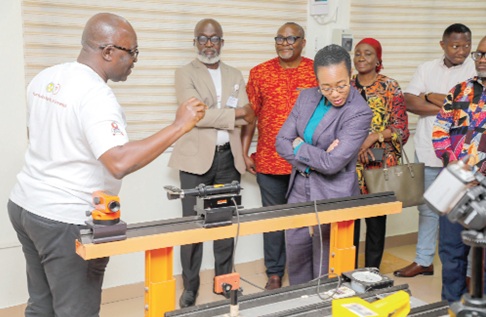
The Minister of Environment, Science and Technology (MEST), Dr Zanetor Agyeman-Rawlings, has issued a directive for the comprehensive audit of all assets of the agencies under the ministry to ensure their efficient management and the prevention of encroachment.
“No agency should sell any assets or land without first telling me; we need to safeguard our assets in the national interest,” she said.
The minister gave the directive during a working visit to some institutions under the Ghana Atomic Energy Commission (GAEC) in Accra last Thursday.
She said the commission’s work was central to national development, spanning nuclear energy, healthcare, food security, environmental protection, mining and scientific research.
“The public should get to know a little bit more about who you are and what you do, because you are everywhere,” she said, citing the commission’s role in areas ranging from medical diagnosis and treatment to water testing, mining and environmental monitoring.
Protect public assets
The minister expressed concern about land encroachment and the need to safeguard public assets, particularly lands and properties belonging to agencies under her ministry.
She said some public assets, once sold, could not easily be recovered, thus making their protection a priority.
Dr Agyeman-Rawlings also urged the commission to protect its observatory and make it more attractive to young scientists to encourage interest in science and help them make informed career choices.
Radiation risks
On public safety, the minister called for increased awareness of radiation-related risks, particularly those associated with telecommunication masts and other facilities.
She expressed concern about the apparent disregard for buffer zones around some telecommunication masts and said the public needed to understand the potential health implications of living within such areas.
She said the commission’s work in radiation monitoring and environmental protection needed to be communicated more effectively to enable people to make informed decisions about their surroundings.
The discussions also highlighted radon, a naturally occurring radioactive gas that can accumulate in enclosed spaces and increase the risk of lung cancer when exposure levels are high.
The minister urged the relevant authorities to expedite efforts to establish safeguards against exposure, including measures relating to building locations and designs.
Officials of the commission said they were working to identify areas with high radon concentration, and collaborate with relevant institutions to develop appropriate guidelines.
Retain skilled personnel
Dr Agyeman-Rawlings said the commission needed to address staff attrition, given the specialised nature of its work and the considerable time required to train experts in nuclear science and related fields.
She observed that it could take an average of 15 years to develop a specialist to a level where the person could make a meaningful contribution to the country.
On the growing application of artificial intelligence (AI), she cautioned against excessive reliance on automated systems in sensitive nuclear operations.
“Personally, I wouldn't want AI in charge of my nuclear power programme,” she said, calling for effective human oversight and safeguards to govern the use of emerging technologies.
She said Ghana needed adequate legal and regulatory frameworks to ensure that the adoption of new technologies did not outpace the safeguards required to manage them.
Nuclear power preparations
Earlier, the Director for Commercialisation and Communication at GAEC, Nana Boateng, said the commission began its nuclear research programme in 1964 and had since expanded its activities beyond nuclear science to include biotechnology, space science, agriculture, healthcare and environmental monitoring.
He said Ghana was progressing through the International Atomic Energy Agency’s (IAEA) milestones approach for introducing nuclear power.
He said the country was undertaking activities, including site identification, community engagement, staff training and engagement with potential technology vendors.
The commission, he added, had established a simulation centre at its School of Nuclear and Allied Sciences to train engineers in operating small modular nuclear reactors.
Funding constraints
Despite its contributions, Mr Boateng identified inadequate research funding, high utility costs and the need to modernise laboratories as major challenges facing the commission.
He appealed for support to modernise laboratories and provide the facilities needed to strengthen research and technology development.
In agriculture, he said the commission was applying technologies such as tissue culture, genetic improvement and radiation processing to improve crop productivity, develop pest-resistant varieties and reduce post-harvest losses.
Commission pledges collaboration
For his part, the Director-General of GAEC, Professor Samuel Dampare, said: “We will continue to collaborate with you and count on your leadership and guidance to advance the prospects of nuclear science and technology for the benefit of Ghanaians and beyond Ghana.”
He reaffirmed the commission’s commitment to working with the ministry to advance nuclear science, research and the application of related technologies for national development.
