
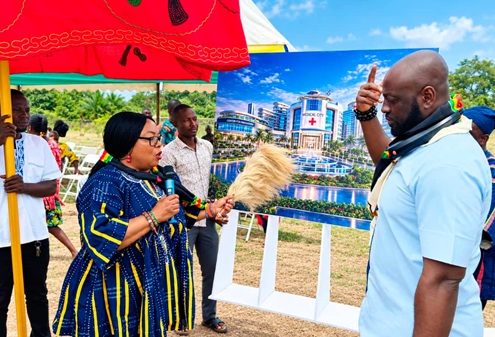
The coastal town of Ada in the Greater Accra Region is uniquely positioned to emerge as a destination for both ecotourism and medical tourism, combining its rich natural attractions with an ambitious plan to establish a multi-billion-dollar medical city that could bring advanced healthcare, technology, research and international investment to the area.
Where the Volta River meets the Atlantic Ocean, Ada has long offered visitors an appealing escape from the bustle of Accra. Its sandy beaches, calm river , mangroves, estuary, birdlife and fishing communities provide a natural setting for relaxation, adventure, cultural experience and nature-based tourism.
Now, the proposed 3,000-acre Global Medical City presents an opportunity to give that tourism economy a new dimension.
The project, an initiative of Africa’s Brain Bank Global, a US-based non-profit organisation, is expected to comprise hospitals, specialist healthcare facilities, research and innovation centres, training institutions and digital health services.
Its promoters envisage a medical destination that will use artificial intelligence (AI), preventive healthcare, digital health technology and telemedicine to provide specialised care while connecting doctors in Ada with medical professionals and specialists in other parts of Africa and around the world.
The convergence of these two opportunities could give Ada a distinctive position in Ghana’s emerging destination economy.
Ada’s ecotourism appeal is rooted in its environment.
The Volta River, Atlantic coastline, wetlands, mangroves and estuary provide opportunities for boating, fishing, birdwatching and other nature-based activities. Its fishing communities and cultural heritage also offer visitors an opportunity to experience life beyond the major urban centres.
The challenge, however, is to transform these natural assets into sustainable economic opportunities for local communities.
Ecotourism can support jobs and businesses in accommodation, hospitality, tour guiding, boat operations, food production, handicrafts and cultural experiences.
The proposed Medical City could complement this existing economy by creating a second stream of visitors, patients, accompanying relatives, doctors, researchers, health professionals and investors.
Medical tourism opportunity
The proposed development comes against the backdrop of Africans travelling abroad for highly specialised medical treatment.
The promoters believe the Medical City could help reduce that outward flow by providing advanced diagnostics, specialised surgery, cancer treatment, preventive healthcare, medical education, research and other high-level services within Africa.
Speaking at the sod-cutting ceremony at Togbloku in Ada on Monday, September 7, 2026, the Chief Executive Officer and Group Chair of Africa’s Brain Bank Global, Rev. Dr Pam Fomunung, described healthcare as an economic driver.
“Healthcare is more than a social service; it is an economic infrastructure,” she said.
Rev. Fomunung said the vision for the project was conceived in 2019 but delayed by the COVID-19 pandemic. Efforts to revive it began in 2023 following discussions with traditional authorities in Ada.
She said the project would require billions of dollars in investment and called on Africans on the continent and in the diaspora to participate.
Technology-driven healthcare
Technology is expected to be at the heart of the proposed Medical City.
The promoters intend to adopt AI-powered clinical services and preventive healthcare, reflecting the growing role of technology in modern healthcare.
The proposed digital health system would also support telemedicine, allowing doctors and specialists who are not physically present in Ada to communicate and collaborate with medical professionals at the facility.
Through such a system, doctors abroad could provide consultations, expertise and specialist support remotely, while medical professionals in Ada could interact with counterparts around the world.
This could create a virtual network of expertise connecting Ada to the global medical community and provide a platform for African doctors in the diaspora to contribute without necessarily relocating permanently.
For Ada, the significance of medical tourism could extend beyond the Medical City itself.
Patients travelling for specialised treatment often require accommodation, transportation, food and other support services. Family members accompanying them may also need places to stay and activities during treatment and recovery.
Ada’s beaches, river environment and cultural attractions could therefore complement medical services by providing opportunities for recreation, relaxation and wellness.
For Rev. Dr Fomunung, originally a Camerounian based in USA who currently is the development queen mother for the Amafuwe of Lomobiawe in Ada, this project could create a broader medical and wellness tourism ecosystem, benefiting hotels, restaurants, transport operators, tour companies and other local businesses.
Dr Michael Kwame Obeng, a Ghanaian plastic surgeon and Board President of the project, said the Medical City would be developed in phases, with the first building expected to be completed and operational within three to five years.
He said the facility would provide quaternary-level care, including highly specialised surgery and cancer treatment, while seeking to attract doctors, scientists and researchers from around the world.
The project could also provide opportunities for African medical professionals in the diaspora to return and practise on the continent.
“This is for the global African continent and beyond,” he said.
Protecting the destination
The dual tourism opportunity also comes with a responsibility to protect Ada’s natural environment.
The beaches, mangroves, wetlands, waterways and coastal ecosystems that support ecotourism must be protected as development accelerates.
Infrastructure will equally be critical. Roads, water supply, electricity, drainage, sanitation, waste management and telecommunications must keep pace with anticipated growth.
The traditional authorities have expressed support for the project.
The Divisional Chief of Lomobiawe, Nene Lomo IV, pledged to work with the promoters, while the Manklalo of the Ada Traditional Council, Nene Obichere Agudey III, called for greater African ownership of development.
A destination with two engines
Ada’s emerging opportunity is ultimately about creating a destination economy with two complementary engines.
Ecotourism can draw visitors through nature, culture and leisure, while medical tourism can attract patients, professionals, researchers and investors through specialised healthcare and technology.
If carefully planned the two sectors can reinforce each other, generating employment and business opportunities while strengthening Ada’s position on Ghana’s tourism map.
The proposed Medical City could add an entirely new dimension to an area already blessed with remarkable natural resources.
The challenge will be ensuring that this transformation is sustainable, inclusive and beneficial to local communities.
If that balance is achieved, Ada could become more than a coastal tourism destination.
It could emerge as a distinctive hub where nature, advanced medicine and technology meet.
Writer's email
