
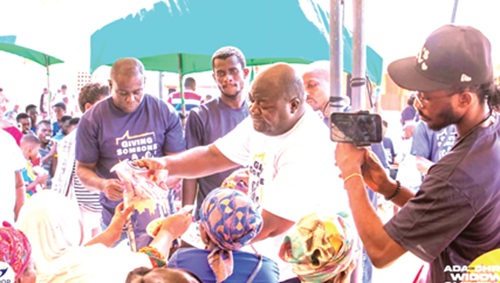
The Call of Diligence (CODOP) Foundation, a charity organisation, has called for stronger enforcement of laws protecting widows from property dispossession, abuse and harmful traditional practices.
Its Executive Director, William Oppong Peasah, urged the Ministry of Gender, Children and Social Protection and other relevant institutions to ensure surviving spouses could access legal protection during an outreach at Kasseh in the Ada East District.
The appeal highlights a broader challenge: ensuring that legal rights translate into security, dignity and economic stability for people who lose their spouses.
“If there is a law that can protect widowhood rights in Ghana, it should be enforced so that our women, our mothers, especially our young widows and widowers, will be protected and helped,” he said.
The death of a spouse can leave a household with reduced income, caregiving responsibilities and uncertainty over property and inheritance. For surviving spouses with limited resources, healthcare costs, children's education and daily living expenses can deepen the hardship.
Ghana's legal framework provides safeguards.
Article 22 of the 1992 Constitution addresses the property rights of spouses, while Article 26 prohibits customary practices that dehumanise or harm a person's physical or mental well-being.
The Intestate Succession Act, 1985 (PNDCL 111), provides for the distribution of the estate of a person who dies without leaving a valid will.
However, the existence of these protections does not automatically guarantee that surviving spouses can enforce their rights.
Limited awareness of the law, the cost of seeking legal assistance and delays in resolving disputes can make it difficult for vulnerable people to challenge dispossession or other forms of abuse.
Mr Peasah said bereavement should not expose surviving spouses to further discrimination.
“Widowhood is not a curse. It is not their fault. Things happen to people in life,” he said.
Beyond immediate assistance
CODOP's outreach attracted more than 2,000 beneficiaries, according to the organisers and included health screening and food distribution.
Peasah said the foundation had conducted outreach activities for 12 years, supporting widows and other vulnerable groups, including prisoners and children in orphanages.
While such interventions can provide immediate relief, sustained support is needed to address longer-term challenges such as income insecurity, inheritance disputes and access to healthcare. Livelihood opportunities, social protection and accessible legal services could complement charitable assistance.
Health concerns also emerged during the outreach, with the CODOP medical team recording very high blood-pressure readings among some beneficiaries.
The foundation's Head of Medical and Research, Dr William Yaw Ofori, said the screening was intended to identify health conditions and facilitate follow-up with the relevant health directorates.
“The blood pressure recordings that we've had today, to be frank with you, are extremely high,” he said.
He urged people to take hypertension seriously by adopting healthier lifestyles, managing stress, getting adequate rest and paying attention to their diet.
Appreciation
A beneficiary, 60-year-old Gladys Aggudey of Ada Foah, thanked the medical team after being informed that her blood pressure was high and received advice on the next steps.
Implications for the SDGs
The call for stronger protection of widows relates directly to Sustainable Development Goal 5 on gender equality and Goal 16 on access to justice and strong institutions.
It also connects to Goal 1 on poverty reduction, as the loss of a spouse can increase financial vulnerability and Goal 3 on good health and well-being through community health screening.
Ultimately, the challenge is to ensure that legal rights are enforceable and that vulnerable people can access the social, economic and healthcare support they need.
Writer's email:
