
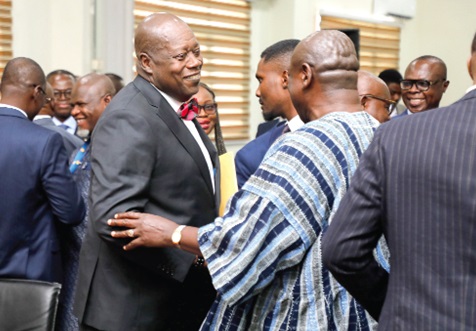
A Justice nominee to the Supreme Court, Anthony Forson Jnr, has strongly opposed proposals to cap the number of Justices on the apex court, arguing that its broad constitutional jurisdiction makes such a move impractical.
He said unless the country decided to reduce the jurisdiction of the Supreme Court, there should be no cap on the number of Justices appointed to the court.
“So, unless, as a country, we decide to reduce the jurisdictions which have been allocated to the Supreme Court, for now, there should be no cap,” he said.
No capping
Appearing before the Appointments Committee of Parliament for vetting last Thursday, Mr Forson, who is a former President of the Ghana Bar Association, said he was among those who opposed capping the membership of the Supreme Court.
He said the justification for expanding the membership of the apex court had clearly established that its previous composition was unable to cope with its workload.
“Indeed, if you look at the write-ups on the justification for the expansion of the membership of the Supreme Court, it was clear that the current composition was unable to cope with the workload.
“So, for now, I disagree that there should be a cap,” he said.
Mr Forson stated that when he responded to a question from a member of the committee, Laadi Ayii Ayamba, who sought his view on whether there should be a cap on the number of Justices on the Supreme Court.
Public Tribunals
The nominee also responded to a question from a member of the committee, Bede Ziedeng, on the establishment of Public Tribunals, particularly concerns from some sections of society over the constitutional provision for such tribunals.
Mr Forson said he had no objection to the establishment of Public Tribunals, pointing out that the Constitution had made provision for them under Article 12.
“So, if the fundamental law of the land provides for it and it is being effectuated, I do not have a problem with it as it is not something which is being imported into the Constitution.
“So, if Parliament is following the law, I have absolutely no problem,” he said.
Professional conduct
Responding to another question from a member of the committee, Faustina Elikplim Akurugu, on how he would ensure that his professional relationships, former clients, colleagues at the Bar and cases involving institutions with which he had previously dealt did not consciously or unconsciously influence his decisions on the Bench, Mr Forson said he would not allow his past relationships to negatively influence his judicial decisions.
He, however, acknowledged that close relationships could unconsciously influence a person's decisions, describing that as part of human nature and drawing on his 29 years of professional experience.
The Supreme Court Justice nominee said his extensive experience in commercial legal practice had shaped his worldview on legal matters, but stressed that his professional responsibilities would prevent him from showing bias towards any individual.
“My professional responsibilities will not allow me to show any bias towards anybody. So I do not think it will have any conflict with my decisions as no matter how many noises are made, the law is the law,” he said.
Mr Forson explained that where a case came before the Supreme Court on appeal, and there was a conflict of interest because he or his law firm had handled an aspect of the matter at the lower court, he would recuse himself.
ICT to tackle case backlog
On how he would advise or support the Chief Justice in finding alternative ways to clear the backlog of cases, Mr Forson pointed to his record at the Ghana Bar Association, where he supported efforts to digitalise its operations.
He, therefore, said he would strongly support the Chief Justice in using information and communications technology (ICT) to accelerate the disposal of cases and reduce the backlog.
“It is doable if the will is there but, of course, there will be opposition,” he said.
Mr Forson also advocated afternoon court sittings as another measure to help clear the backlog of cases.
“There will be opposition because the lawyers will say that they need their rest, but we have to move forward; it is doable,” he said.
Commendation
The Chairperson of the Appointments Committee, Bernard Ahiafor, commended Mr Forson for demonstrating consistent professionalism throughout his career at the Bar.
“Your qualification under the Constitution of the Republic of Ghana as a Supreme Court judge is not in doubt, and your professionalism and conduct as a lawyer are also not in doubt,” he said.
“I know you are capable of working as a Supreme Court judge and you deserve to be nominated,” Mr Ahiafor added.
