
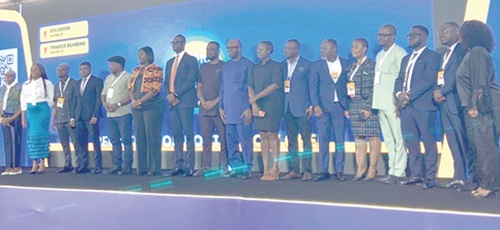
The Minister of Communication, Digital Technology and Innovations, Sam Nartey George, has encouraged stakeholders in the technology and financial sectors to deepen collaboration in order to develop solutions that respond to Ghana’s real economic challenges and have the potential to scale beyond the country.
He said collaboration among academia, startups, developers, investors, regulators and financial institutions would give the country a real advantage in the sector.
The minister made the call in Accra at the launch of the MoMo Tech Lab, a three-month innovation programme designed to identify, nurture and support fintech talent while developing practical digital solutions capable of improving livelihoods and strengthening Ghana’s position as a hub for financial technology innovation.
He said the country could no longer view fintech as merely an emerging technology sector, given its growing role in facilitating economic activity and expanding access to financial services.
Innovation ecosystem
Mr George said mobile technology had significantly transformed the financial landscape by enabling people who were previously excluded from the formal financial system to access payments and other financial services through their mobile phones.
He said the development had created opportunities for millions of Ghanaians, including small-scale traders, farmers, young entrepreneurs and other groups that depended heavily on accessible and affordable financial services.
He stressed, however, that the expansion of fintech should not come at the expense of trust and safety, insisting that innovation must be supported by strong governance structures.
He identified consumer protection, cybersecurity, data privacy and regulatory compliance as essential pillars for the sustainable development of the fintech ecosystem.
Mr George, therefore, called on universities to establish stronger links between academic research and industry by encouraging students to develop final-year projects and research around real-world challenges that could eventually be transformed into viable products and businesses.
He also encouraged technology communities and experienced professionals to mentor young innovators, while urging investors to provide the capital required to move promising ideas from the development stage into sustainable businesses.
Outcomes
Mr George said the success of the MoMo Tech Lab should ultimately be determined by tangible outcomes rather than the number of participants or activities undertaken during the programme.
He further challenged stakeholders to ensure that the ideas generated through the programme were developed into sustainable ventures that could create jobs, attract investment and contribute to Ghana’s digital economy.
Regulatory compliance
The Head of Fintech Regulations at the Bank of Ghana, Owureku Asare, said the regulator’s priority was to ensure that fintech companies operated within the applicable legal and regulatory framework while protecting the interests of customers.
He urged young innovators to engage the central bank early in the development of their products so that regulatory requirements could be understood and incorporated into their solutions from the outset.
He encouraged participants to take advantage of the Bank of Ghana’s innovation hub as a platform for obtaining regulatory guidance and understanding the requirements applicable to fintech products and services.
Mr Asare also urged the innovators to use the MoMo Tech Lab as an opportunity to develop solutions that met the required standards for cybersecurity, data protection and regulatory compliance.
Talent search
The Chief Executive Officer (CEO) of MoMo Fintech Limited, Shaibu Haruna, said the MoMo Tech Lab would be implemented across three zones, namely Accra, Kumasi and Tamale, to ensure that fintech talent from different parts of the country got the opportunity to participate.
He said the geographical approach was intended to widen the talent pool and create opportunities for innovators outside the capital to contribute to Ghana’s growing digital economy.
Mr Haruna said the programme would provide participants with opportunities to develop and refine their ideas, receive mentorship and work towards creating solutions with practical commercial applications.
