
The National Anti-Illegal Mining Operations Secretariat (NAIMOS) has launched ‘Operation Green Shield’, in a renewed commitment to weed out illegal miners from the Atewa Range Forest Reserve in the Eastern Region.
The special military operation, scheduled to start in two weeks time, will feature specially trained military personnel conducting forest operations, followed by sustained patrols and surveillance to prevent illegal miners from returning to the forest.
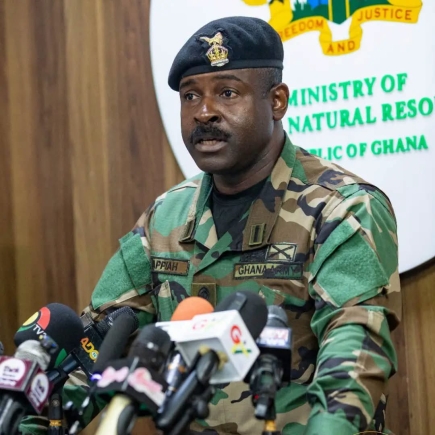
The Director of Operations at NAIMOS, Col. Kwame Sam Appiah, explained that the operation would be carried out in three stages — clearing and disrupting illegal mining, holding and stabilising the forest reserve, and transitioning and handing it over to the Forestry Commission for management.
He added that the aim of the operation was to “disrupt illegal mining in priority areas, deny renewed access, and create the conditions for sustained protection of this strategic watershed.”
“The intended outcome is a reserve in which priority hotspots have been cleared and stabilised, with routine protection progressively transferred to Forestry Commission guards,” Col. Appiah said at the inaugural edition of the Ministry of Lands and Natural Resources Progress Reports Series, an initiative meant to provide updates on activities of agencies under the ministry.
The inaugural edition, held Thursday (Oct 22, 2026), saw the NAIMOS Operations Director providing an update on its fight against galamsey, covering the period June 13 to the end of September, this year.
Forest protection key
Col. Appiah emphasised that protecting the Atewa Forest from destruction was critical because it would strengthen the wider effort to safeguard river sources and support environmental recovery.
“This reflects a central principle of our operational design: enable transition to permanent agency-led protection of forest reserves, watersheds and river systems,” he said.
He said the ‘Operation Green Shield’ approach would be extended to other forest reserves on needs assessment basis to ensure that illegal miners were completely cleared off critical ecological resources.
Context
The government, through the Ministry of Lands and Natural Resources, established the NAIMOS on July 23, 2025 to serve as a centralised command and operational nerve-centre against illegal small-scale mining (galamsey).
The Secretariat was set up to act as an intelligence-led multi-agency hub to coordinate the Ghana Armed Forces (GAF), Police Service, Immigration, National Investigations Bureau (NIB), Narcotics Control Commission (NACOC) and environmental agencies.
Its operation was backed with an initial funding allocation of GH¢150 million to scale up field operations, surveillance and permanent deployments along critical water bodies and forest reserves.
Updates
Touching on the activities of NAIMOS from the time he took over its leadership on June 13 up to September 30, he said the team conducted 738 operations covering a cumulative distance of 50,662 kilometres, comprising reconnaissance, mobile and riverine patrols, raids, special operations and community engagement.
“Our task forces recovered 74 firearms and 551 rounds of ammunition.
They also seized excavators, pumps, vehicles and other equipment used to support illegal mining,” he said.
Again, he said more than 100 excavators, 1,970 chanfang machines and 863 makeshift structures were destroyed, disrupting mining capacity and the infrastructure that sustained it.
“Suspects were also apprehended and handed over to the appropriate authorities for investigation and further action.
Our responsibility extends to preserving evidence and supporting the justice process so that enforcement can produce credible deterrence,” he added.
Commitment
Col. Appiah stressed that NAIMOS was committed to clamping down on all forms of illegal mining through coordinated deployments, sustained swoops, mobile interventions, establishment of more forward operating bases (FOBs).
He said having made modest gains in the galamsey fight after more than a year of its establishment, the secretariat would embark on planned deployments, combining land and riverine operations to weed out illegal miners.
“To those engaged in illegal mining, the direction is clear.
Mining in our rivers, forests, farms and plantations must stop; our enforcement effort will continue against illegal miners and the networks sustaining them, in cooperation with the institutions responsible for investigation and prosecution.
“Individuals and groups who continue to pollute our rivers, degrade our forests and decimate critical national infrastructure, including roads, will be dealt with decisively,” he assured.
Col. Appiah added that the secretariat would not relent in delivering on its mandate of protecting the country's land and water resources from destruction by illegal miners.
“We must judge progress by whether cleared areas remain secure, illegal activity declines, cases advance through the justice system and environmental recovery becomes measurable.
We will seek close cooperation with the relevant environmental and water institutions to assess those outcomes,” he said.
