
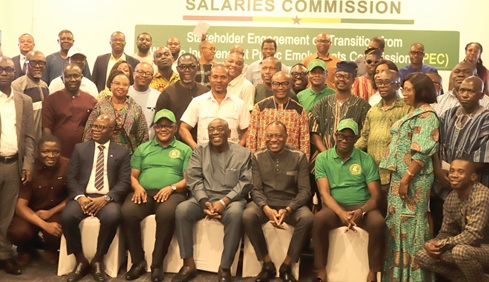
The first in the series of stakeholder engagements for the transition of the Fair Wages and Salaries Commission (FWSC) into an Independent Public Emoluments Commission (IPEC) began in Accra last Thursday.
The move is to incorporate stakeholders' input into the draft bill that would see the transition of the FWSC to an independent commission.
Participating groups at the engagement included Organised Labour.
The independent commission is expected to play a crucial role in promoting fairness and transparency in public-sector pay and its establishment is seen as a significant step towards public-sector reform.
Decision
Speaking at the engagement, the Minister of Labour, Jobs and Employment, Dr Abdul-Rashid Hassan Pelpuo, said the decision to engage key stakeholders, particularly Organised Labour, demonstrated "our collective commitment to consolidation, transparency and inclusiveness in shaping an institution that will have a significant bearing on Ghana's public sector wage and compensation system".
He said the issue of public sector compensation was not mainly a matter of numbers, salaries and allowances, but fundamentally about people.
"Not just about people, it's about the livelihood of people, it's about the fairness that we experience at work, it's about the productivity we put across or we put about in our work.
"It is also about the sustainability of our national economy, which is the basis upon which all these things thrive," Dr Pelpuo said.
Remuneration
For workers, and in accordance with the law, the Minister said remuneration must be fair and decent while reflecting the value of workers' contributions to national development.
He said that, for the government and taxpayers, however, the compensation bill must remain fiscally responsible, reasonable and sustainable.
"The challenge before us, therefore, is to find the right balance between fair remuneration for public sector workers and the broader fiscal capacity of the state.
“This is why today's engagement is particularly important," he said.
The proposed independent commission, he said, represented an opportunity to strengthen the institutional framework for determining the management of public sector emoluments.
Dr Pelpuo said the transition must, however, be carefully considered to ensure that a new framework would promote fairness, independence, transparency, consistency and accountability.
As a ministry responsible for labour, jobs and employment, he said: "Our interest is clear and it is that the protection and advancement of the interests and welfare of workers must remain at the heart of our national labour policies".
Compensation
For his part, the Chief Executive Officer of the FWSC, Dr George Smith-Graham, said a credible compensation system must be capable of recognising legitimate differences.
"But that principle has an equally important second half: every difference in compensation must rest on a fair, objective, transparent and defensible reason.
"That is where trust begins. Workers should not be left to speculate why one group receives one form of treatment, while another receives something different," he said, adding that "where differentiation is justified, the basis must be clear and understandable."
The Secretary-General of the Trades Union Congress, Ghana (TUC), Joshua Ansah, said Organised Labour was committed to the establishment of the independent commission.
He urged the government not to approach the exercise in a piecemeal manner.
