
A monitoring and evaluation report on irrigation schemes has rated their performance at 89.6 per cent, classified as “excellent”.
The evaluation covered the Aveyime, Dawhenya and Ashaiman irrigation schemes and assessed their infrastructure rehabilitation, training of trainers (TOT), training of leaders (TOL), farmer field schools (FFS) and action plans implemented under the project.
An expert team from the Korea International Cooperation Agency (KOICA), which supported the rehabilitation of the three agricultural irrigation projects, conducted the evaluation before their official handing over to the Ghana Irrigation Development Authority (GIDA).
The monitoring and evaluation team scored infrastructure 91.0 per cent, action plans 91.6 per cent, and farmer field schools 91.2 per cent, all classified as “Exceptional”.
TOT recorded 86.2 per cent, while TOL recorded 88.2 per cent, both classified as “Excellent”.
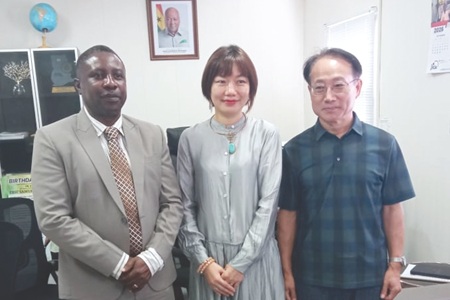
The Chief Strategy Officer of JH Sustain International Development Consulting, Hong Ilpyo, who briefed the Chief Executive Officer (CEO) of the Ghana Irrigation Development Authority (GIDA), Samuel Eric Adu-Dankwa, on the evaluation findings, said the assessment demonstrated significant improvements in irrigation infrastructure and farmers’ capacity.
The evaluation was conducted by JH Sustain International Development Consulting under the KOICA/GIDA project.
Infrastructure improvements
Despite the excellent evaluation, Mr Hong said the team identified the high cost of pumping water from the Volta River to the storage facility as one of the major challenges of the Aveyime Irrigation Scheme.
To address the challenge, the project has installed a 75-kilowatt solar power system to reduce the scheme’s dependence on expensive electricity for pumping.
The Chief Strategy Officer of the consulting firm said the project also rehabilitated irrigation canals and introduced concrete-lined canals to improve water conveyance and reduce water losses.
The intervention, he stated, had reduced the time required for water to travel through the irrigation system from about four hours to approximately one-and-a-half hours, with water losses expected to reduce significantly, Mr Hong explained.
He said the storage capacity of the Aveyime scheme had also been expanded from 4,000 cubic metres to 6,000 cubic metres, providing additional capacity for irrigation water supply.
At Ashaiman, Mr Hong said the project rehabilitated the old reservoir and improved the irrigation and drainage systems.
He said the existing drainage canal, which was about five metres wide, was expanded to approximately 20 metres to reduce flooding during the rainy season.
Improved farming practices
Mr Hong said the project also placed considerable emphasis on capacity building through TOT, TOL, FFS and action plans.
He said farmers were trained in water management, efficient fertiliser application and improved agricultural practices, including rice transplanting techniques introduced from South Korea.
He said evidence gathered from farmers showed that some farmers recorded an increase of more than 48 bags of rice per hectare, translating into additional revenue of about $2,000 and increased income of approximately $900 per hectare, based on the evaluation findings.
Mr Hong also highlighted the economic benefits of the intervention at Ashaiman, where a rice milling facility was provided, which would save farmers between $15,000 and $17,000 annually.
GIDA endorsement
Speaking on the report, the CEO of GIDA, said the monitoring and evaluation had provided useful evidence on the impact of the project.
He said, for instance, the evaluation showed that the rehabilitation of the irrigation canals had significantly shortened the time required to convey water to farmers.
“Initially, water transport or conveyance took so long, about four hours, but through the lining of the canal, the project has now shortened it to about an hour,” he said.
Mr Adu-Dankwa further noted that there was improvement in water storage at the schemes and the training of farmers, which had equipped them with new skills that were contributing to improved productivity and higher crop yields.
Evaluation findings
The CEO and Founder of JH Sustain International Development Consulting, Irene Park, said the evaluation showed that farmers expressed high satisfaction with the infrastructure provided under the project.
The Aveyime scheme recorded an infrastructure satisfaction rating of 87.5 per cent, while Dawhenya recorded 92 per cent and Ashaiman 91.5 per cent.
“Overall, the report indicated that the project has adopted a balanced approach to infrastructure improvement and capacity building, but stressed that continued maintenance of facilities and sustained farmer-led activities would be essential to maintaining the gains,” Ms Park stated.
