
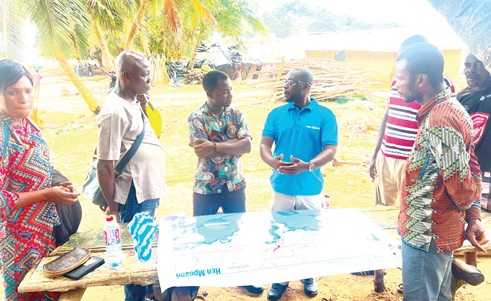
Deep inside the Cape Three Points Forest Reserve, where towering trees once shielded rivers that flow quietly into the Gulf of Guinea, the unmistakable scars of illegal mining are spreading across one of Ghana's richest biodiversity hotspots.
The destruction would appear to be a forest problem, but conservation experts say it threatens something far bigger: the future of Ghana's fisheries and the success of the country's first Marine Protected Area (MPA), a flagship initiative under the global 30x30 biodiversity target to restore depleted fish stocks and protect marine ecosystems.
When the Daily Graphic visited Cape Three Points, to enquire of the state of the forests in the area, environmental scientists, fishing communities and conservation groups all returned to one central message: protecting the ocean would be difficult if the forest feeding it continues to disappear.
Standing over a large ecological map linking the Cape Three Points forest cover to the newly designated Marine Protected Area, the Deputy Director of Hɛn Mpoano, Stephen Kankam, said Ghana risked undermining years of marine conservation efforts if it continued to manage the forest and the sea as two separate ecosystems.
"The Marine Protected Area does not begin in the sea," he said, pointing to rivers flowing from the forest into the Atlantic Ocean. "It actually begins here."
Mr Kankam explained that rivers including the Nyan, Butre and Ezele carry nutrients, sediments and freshwater from the forest into coastal wetlands, mangroves and eventually the Marine Protected Area, where they sustain fish breeding grounds and nursery habitats.
Ecological connection
As mangroves and estuaries depend on this ecological connection, any destruction of the forest upstream inevitably affects marine life downstream.
According to him, this natural relationship means that protecting fish stocks could not be achieved solely by restricting fishing activities.
Unless the Cape Three Points forest cover is protected from illegal mining, deforestation and encroachment, he warned, Ghana's investment in marine conservation could fail to deliver its intended results.
He noted nutrients, sediments, vegetation and genetic resources from the forest are naturally transported through these waterways into the inshore marine environment, creating conditions that support fish breeding and sustain marine biodiversity.
Mangrove forests, he said, serve as vital nursery grounds where young fish grow before moving into deeper waters.
"Any activity happening in the forest eventually affects what happens in the sea," he stressed.
"It is impossible to protect the sea while allowing the forest that supports it to be destroyed."
Illegal mining threat
Despite its ecological importance, the Cape Three Points forest cover is increasingly coming under pressure from illegal mining.
Mr Kankam said mining activities have expanded within sections of the forest, as well as adjoining rivers, wetlands and streams, threatening the integrity of the entire coastal ecosystem.
"At the moment, there is significant mining activity," he said.
"As you can see from the maps, the red portions indicate mining not only inside the forest but also along rivers and wetlands."
He warned that unless immediate action was taken, the destruction would undermine efforts to restore marine ecosystems under the country's first Marine Protected Area.
To halt the degradation, he called for permanent protection camps to be established inside the forest reserve, enabling security agencies to maintain a round-the-clock presence and swiftly respond to illegal mining activities.
Mr Kankam said protecting the forest and the sea required a new conservation model built on collaboration rather than fragmented management.
He proposed stronger coordination among the Forestry Commission, the Wildlife Division, the Fisheries Commission, the Ministry of Fisheries and Aquaculture, the Environmental Protection Agency, district assemblies, traditional authorities, tourism operators, private companies, oil and gas firms, civil society organisations and local communities.
He therefore advocated converting the Cape Three Points forest cover into a national park to complement the Marine Protected Area and allow both ecosystems to be managed as one ecological unit.
According to him, such an approach would strengthen biodiversity conservation while improving fish stocks, supporting tourism and protecting livelihoods.
Mr Kankam acknowledged that many coastal communities still have concerns about the Marine Protected Area, particularly regarding alternative livelihoods and infrastructure.
He, however, explained that livelihood diversification programmes have already begun on a pilot basis, with between 150 and 200 young people receiving vocational training in carpentry, dressmaking, catering and other trades.
Roads and tourism
Mr Kankam said fixing the deplorable roads linking Cape Three Points and surrounding communities would be essential if the government hoped to unlock tourism opportunities associated with the Marine Protected Area.
He noted that improved roads would not only benefit tourism but also support fishing communities, improve access to healthcare, facilitate trade and strengthen public support for marine conservation.
According to Mr Kankam, work is currently underway to prepare the Marine Protected Area's management plan through extensive consultations with fishing communities, traditional authorities, government agencies and other stakeholders.
The plan is expected to be completed by the end of this year, with full implementation scheduled to begin in January 2027.
He said Ghana's model would place communities at the centre of decision-making while combining scientific evidence with local ecological knowledge.
"Our biggest lesson is that conservation succeeds when communities lead it," he said.
"But protecting the sea alone will not be enough."
"If we truly want healthy fish stocks, thriving tourism and resilient coastal communities, then we must first protect the forest that gives life to the sea."
Communities share the concern
Many community members interviewed by the Daily Graphic said illegal mining was steadily degrading the forest while poor roads continued to isolate communities that are expected to benefit from marine conservation.
A fish processor at Akwidaa, Grace Ansah, said protecting the forest should become a national priority.
Another fish processor, Sophia Buah, blamed unemployment for increasing illegal mining.
A veteran fisherman Charles Cromwell, who has spent more than four decades fishing around Cape Three Points, also backed stronger protection for the forest.
