
Radiation protection experts have urged employers to protect workers from heat and light exposure from lamps, lasers and other equipment, as prolonged exposure could cause harm to the skin and eyes.
They also advised them to establish safety procedures specific to equipment being used at their respective workplaces.
The experts explained that energies emanating from such heat and lights were known as non-ionising radiation, which comes from sources such as sunlight, mobile phones, Wi-Fi devices, television, radio transmitters, and electricity infrastructure.
They said that although non-ionising radiation was widely used in communication, health care, industry and other areas, some sources could harm the eyes or skin when exposure was excessive, or safety measures were ignored.
The experts also urged workers to follow safety instructions, observe restrictions around hazardous equipment and use appropriate protective eyewear and clothing to reduce exposure.
The speakers were a Senior Research Scientist and Manager, Health Physics Centre, Radiation Protection Institute (RPI), Philip Deatanyah; Head of Resource, Market Access and Compliance at the Regulatory Administration Division of NCA, Roland Yaw Kudozia; and the Programmes Manager of Ghana Investment Fund for Electronic Communications (GIFEC), Desire Akakpo.
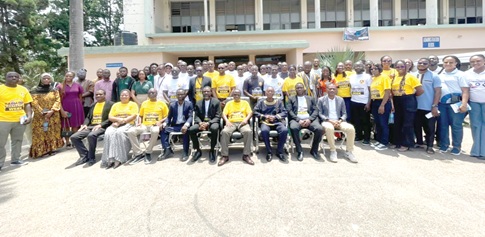
They were speaking at a maiden non-ionising radiation symposium organised by the Ghana Association for Radiation Protection (GARP), in Accra, as part of the Radiation Protection Week celebration.
The symposium, which was on the theme: “Radiation safety: Protecting the public, patients, workers, and the environment,” brought together researchers, regulators, industry players and other stakeholders who discussed the safe use of non-ionising radiation and ways of strengthening radiation protection in Ghana.
It was supported by the Radiation Protection Institute, GIFEC, the National Communications Authority (NCA), and the Nuclear Regulatory Authority (NRA).
Significance
The President of GARP, Prof. Joseph K. Amoako, said it was important for people to understand the particular type of radiation they were dealing with and avoid treating all forms of radiation as the same.
Mr Deatanyah also said that non-ionising radiation was present in everyday technologies and infrastructure, including mobile phones, base stations, Wi-Fi systems, broadcasting facilities, transmission lines, substations and transformers.
He also mentioned magnetic resonance imaging (MRI), therapeutic lasers and UV equipment used for sterilisation as other sources.
Mr Deatanyah said plans were underway to map radio-frequency and electromagnetic field levels around communities and infrastructure, and also assess exposure to electromagnetic fields, UV radiation and lasers.
NCA measures
Mr Kudozia said the authority had put measures in place to protect consumers, including requiring communication equipment to undergo type approval and safety testing before being placed on the Ghanaian market.
He urged consumers to check that mobile phones and other communication devices had been approved by the NCA before purchasing them.
For his part, Mr Akakpo said radio-frequency energy from properly installed and regulated telecommunications towers was generally far below internationally accepted safety limits, adding that exposure decreased rapidly with distance from the source.
He said in many circumstances, a person using a mobile phone close to the ear could be exposed to higher radio-frequency energy than someone living near a telecommunications tower.
