
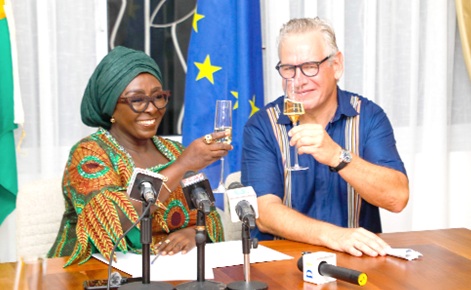
The European Film Festival has returned to Ghana after a five-year break, with this year’s edition seeking to strengthen cultural ties between the country and Europe through film and creative collaboration.
The festival, which was launched in Accra last Monday, is being held on the theme, “Peace, Tolerance and Inclusivity”.
The week-long event which will run until October 11, is expected to bring together filmmakers, creative professionals and audiences to showcase films, discuss opportunities in international markets and funding, develop filmmaking skills and promote partnerships between Ghanaian and European creatives.
The return
Opening the festival, the European Union (EU) Ambassador to Ghana, Rune Skinnebach, said the return of the festival reflected the power of cinema to promote understanding between people from different cultural and social backgrounds.
He said film provided an avenue for people to see the world through the experiences of others and to recognise shared values despite differences in culture and nationality.
“Film can make us listen to voices we do not normally hear. It can challenge our assumptions.
It can make us laugh together and sometimes cry together,” he said.
Mr Skinnebach said the theme of the festival was deliberately chosen to reflect values that were important in the current global environment, adding that culture should be accessible to all and serve as a tool for creating opportunities and bringing communities together.
He said the EU’s partnership with Ghana’s creative sector included initiatives such as Sankofa II and the Africa-Europe Partnerships for Culture, which supported Ghanaian artists and creative professionals, including those in film and animation.
“Ghana has no shortage of stories to tell. What matters is making sure that Ghanaian storytellers have the platforms, partners and audiences to take those stories further,” he said.
Creative industry
The Minister of Tourism, Culture and Creative Arts, Abla Dzifa Gomashie, said film remained a powerful tool for telling stories, preserving memories, shaping identities and connecting people across cultural and national boundaries.
She said Ghana’s cultural and creative industries contributed to national identity, employment, entrepreneurship, tourism and international engagement, particularly by creating opportunities for young people.
She said stronger partnerships between the government, local creative practitioners and international partners were required to create opportunities for Ghanaian talent to reach wider audiences.
She said cooperation between Ghana and the EU presented opportunities for co-productions, capacity building, knowledge exchange, technology transfer, cultural dialogue and greater access to international markets for Ghanaian creative works.
The minister said the country’s challenge was not a shortage of talent but limited opportunities for local creatives to share their work with the world.
“I’m grateful that the European Union is taking the lead in creating the platform,” she said.
Mrs Gomashie also highlighted EU support for the revision of Ghana’s Cultural Policy, describing the revised policy as an important framework for strengthening the cultural sector and placing culture and creativity more firmly within the country’s national development agenda.
She said the EU, through the Sankofa II project, had also committed support towards the national sensitisation and dissemination of the revised Cultural Policy.
The minister urged Ghanaian filmmakers and other creatives to tell Ghanaian stories boldly and authentically while producing works capable of connecting with audiences across Africa, the diaspora and the wider world.
