
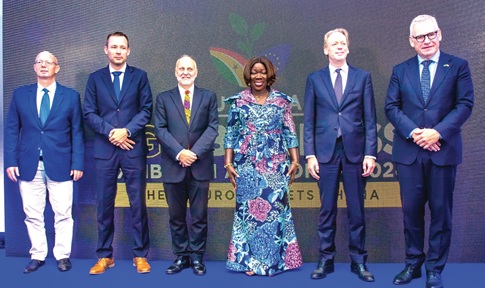
Thirty Ghanaian agribusiness companies selected from nearly 100 applicants have showcased their products and explored export and investment opportunities alongside European businesses at the EU-Ghana Agribusiness Exhibition Forum and Trade Mission 2026 in Accra.
The two-day event, on the theme: “Where Europe meets Ghana”, attracted 42 exhibitors and more than 650 registered visitors.
It brought together government officials, the diplomatic corps, investors, farmers, processors, exporters, financial institutions and technology providers to explore partnerships to strengthen Ghana’s agricultural value chains.
It was also aimed at translating business discussions into investments, technology transfer, expanded markets and local processing opportunities.
Value addition
At the opening ceremony in Accra, the Minister of Trade, Agribusiness and Industry, Elizabeth Ofosu-Adjare, speaking on the theme: “Driving real investment, innovation and sustainable agribusiness in Ghana”, said the country was intensifying efforts to increase value addition through expanded domestic processing, industrial parks and strategic partnerships with foreign investors.
She called on European companies to move beyond traditional buyer-seller arrangements and invest in joint ventures, processing facilities and supplier-development programmes to strengthen the country’s productive capacity, create jobs and increase export earnings.
The minister said the government wanted the country to move beyond exporting raw agricultural commodities and retain a greater share of the value generated from its produce.
Cocoa processing
Mrs Ofosu-Adjare said fluctuations in global commodity prices, particularly cocoa, had demonstrated the risks associated with depending heavily on raw material exports.
She cited the fall in global cocoa prices from about $10,000 per tonne in early 2025 to approximately $4,000 in early 2026 as an indication of the vulnerability of an economy that exported raw commodities while leaving much of the value creation to other countries.
“Ghana has set a target to process at least 50 per cent of its cocoa domestically. We have already installed grinding capacity of over 500,000 metric tonnes.
“The direction is set, and it will not reverse. The result of this pivot towards value addition is already visible in our non-traditional exports,” she said.
Mrs Ofosu-Adjare said opportunities also existed to process cashew, fruits and vegetables, cassava, maize, rice, oil palm and shea into higher-value products for domestic consumption and export.
She urged Ghanaian businesses to identify the financing, technology and market linkages needed to expand and encouraged European investors to consider partnerships that would strengthen local productive capacity.
European partnership
The Executive Director of the European Chamber of Commerce in Ghana (EUROCHAM), Nicolas J. Gebara, urged European businesses to support Ghana’s agribusiness transformation through technology, expertise, investment, financing and access to the European market.
He said the panel discussions and masterclasses would help address the needs of farmers, agribusiness entrepreneurs and industrialists.
Mr Gebara, however, indicated that the strong response from businesses demonstrated the growing interest in developing Ghana’s agribusiness sector and taking advantage of opportunities in local and export markets.
He said the EU-Ghana Economic Partnership Agreement (EPA) offered significant opportunities for Ghanaian agribusinesses to expand into the European market through duty-free, quota-free access for eligible products.
The European Union Ambassador to Ghana, Rune Skinnebach, said the EU was ready to support the country’s efforts to increase value addition through investment, technology transfer and expertise.
He said Ghana needed to invest in processing, storage, cold-chain infrastructure, packaging and branding to increase the value of its agricultural produce and expand access to regional and international markets.
In view of the EPA, he stressed that exporters needed to meet EU requirements on food safety, quality and traceability to take full advantage of the opportunities.
The Vice-President and Head of West Africa at AAK, Lasse Skaksen, reaffirmed the company’s commitment to establishing a manufacturing facility in Tema to strengthen local processing and improve the competitiveness of Ghanaian shea products.
