
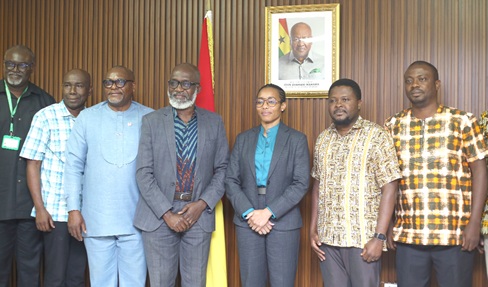
The Minister of Environment, Science and Technology (MEST), Dr Zanetor Agyeman-Rawlings, has stated that her first 100 days in office will be focused on building a robust ecosystem as the foundation on which the country can ride to become a hub of space-based technologies.
She said the vision was anchored on five strategic pillars – institutional transformation, development of space infrastructure and data, leveraging space for environmental sustainability and climate action, building the right human capital in the space sector and promoting space entrepreneurship through private sector partnerships.
The Korle Klottey Member of Parliament (MP) said the world was increasingly moving towards the new space economy, for which reason more attention must be given to initiatives that would ensure rapid advancement in satellite technology, artificial intelligence (AI), earth observation, telecommunications, robotics, remote sensing and data analytics.
“Every day, space-based technologies support activities that affect our lives, whether we recognise it or not.
They support telecommunications and broadcasting, weather forecasting, navigation, financial transactions, agriculture, environmental monitoring, disaster management, maritime surveillance, national security and scientific research; and that is why we must prioritise it,” she stressed.
She stated this during an engagement with the media after a strategic meeting with the heads of agencies under MEST, including the Ghana Atomic Energy Commission (GAEC) and the Ghana Space Science Institute (GSSTI).
The meeting was meant to discuss how the country could strategically position itself to use space science and technology to solve developmental challenges, create economic opportunities, strengthen national resilience and prepare young people for the economy of the future.
Vision
Dr Agyeman-Rawlings said she was committed to leading the Reset Ghana Agenda at MEST in line with the government’s vision to integrate science, technology and innovation into the broader national development architecture to propel the country’s advancement.
She said that vision was particularly important because space technology provided powerful tools for addressing environmental and climate-related challenges.
“Through earth observation and geospatial technologies, we can obtain information on forests and land-use change; water resources; coastal erosion; illegal mining; environmental degradation; flood-prone areas; drought and climate variability; agricultural conditions; urban expansion; and marine ecosystems. This creates an enormous opportunity to move from reactive environmental management to evidence-based and predictive environmental governance,” she stressed.
Concrete action
Touching on institutional transformation, the minister said her preoccupation was to work with all stakeholders to ensure that the GSSTI was transitioned into an agency.
She said although the GSSTI had played an important role in building the country’s capabilities in space science and technology, there was the need to evolve the institutional arrangements to meet new ambitions.
“The government will, therefore, work towards leveraging the Ghana space policy to facilitate the transformation of the GSSTI into a fully fledged Ghana Space Agency, with the appropriate legal, institutional, technical and operational framework,” she said.
The minister said the Ghana Space Agency would be a state institution that had the objective to coordinate Ghana's space activities; develop national space programmes; facilitate research and innovation; promote public-private partnerships; coordinate international cooperation; and support the development of space infrastructure.
Dr Agyeman-Rawlings said the next priority area was to build space infrastructure and access to reliable space-based data.
She added that the way forward to leveraging the potential of space technology was to invest deliberately in human capital.
In that regard, she said the government would promote stronger collaboration among universities, research institutions, industry, government agencies and international partners.
