
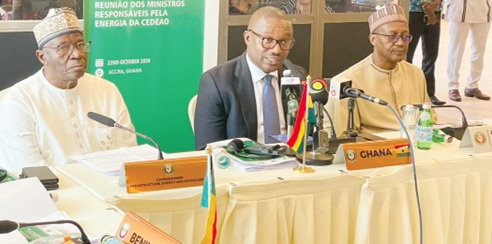
West Africa's energy future will not be won by how much power it generates, but how smartly it stores, trades and protects it, Minister of Energy and Green Transition, Dr John Abdulai Jinapor, has said.
Addressing the 16th ECOWAS Energy Ministers Meeting in Accra last Thursday, he called for enhanced regional cooperation, investor certainty and a shift from generating more megawatts to using power more intelligently.
He announced Ghana's major pivot to storage and said the government was procuring a grid-scale Battery Energy Storage System of 200MW with over 1,500 MWh of stored energy, backed by a dedicated 200 MWp solar photovoltaic plant to charge it.
"The future of energy is not simply about generating more electricity. It is about using the electricity we generate more intelligently," Dr Jinapor told his counterparts.
According to him, storage will help West Africa manage peak demand, integrate renewables, cut avoidable generation costs and keep the lights on when households and industries need it most.
On sector sustainability, the minister said the government was pursuing tough reforms to fix financial imbalances, enforce payment discipline and rebuild investor confidence in the energy sector.
Caution
Dr Jinapor also issued a stark warning on petroleum security.
Citing the Middle East crisis and its ripple effects on fuel prices and cost of living in Africa, he said Africa cannot remain exposed while sitting on its own crude.
He said the country’s long dependence on imported refined products, despite being an oil producer, had exposed it to global shocks, hence the government's policy to revive local refining.
He pointed to the Tema Oil Refinery and Sentuo Oil Refinery as critical to reducing import dependence and improving supply resilience.
"Producing crude oil is important, but its full value is realised when we can also refine it, store it and supply finished products," he said.
Regional market
For the regional market, Dr Jinapor called for predictable rules.
He said the capital needed for energy infrastructure would only flow where licensing, tariffs, contracts and dispute resolution were clear and consistently applied.
He proposed a bold model of complementary trade - Nigeria's gas powering Ghana's generation and transmission infrastructure, with surplus electricity wheeled to neighbours.
He urged the ministers to back five priorities: regulatory certainty, stronger regional cooperation, financially sustainable systems, inclusive industrial development and effective implementation.
"The future of West Africa's energy sector will not be determined by what any one country can achieve alone," Dr Jinapor stressed.
Directives
For his part, the Commissioner for Infrastructure, Energy and Digitalisation at the ECOWAS Commission, Amin Amidu Sulemani, warned that despite abundant resources, only 61 per cent of West Africa's population had access to electricity, leaving nearly 180 million people without power.
"This is not simply a statistic; it is a call to action," he told the ministers.
He said the region still faced insufficient generation, high losses, limited rural access and low investment in renewables and stressed that tomorrow's needs could not be met with yesterday's systems.
He urged the ministers to consider two pivotal instruments already reviewed by experts in Accra.
Thus, a “Directive on Battery Energy Storage Systems” to harmonise rules and attract private investment for grid stability and an “amendment to the Regional Electricity Market Levy to properly resource ECOWAS Regional Electricity Regulatory Authority (ERERA), West African Power Pool (WAPP) and the System Market Operator” to ensure they had the resources needed to carry out their oversight and operational responsibilities effectively.
