
Advocacy organisation, Africa Education Watch (Eduwatch), has called on the government to develop a comprehensive and fully costed policy for public basic schools in the country.
It said after two decades of the implementation of the Free Compulsory Universal Basic Education (FCUBE), there was no policy to that effect and that a "policy will define the parameters of what is free. It will define the government commitment to free basic education".
It said a comprehensive policy would define the responsibilities of the various actors - statutory and non-statutory when it comes to basic education.
Moreover, it said it would define the role of the local government in basic education.
Again, it said a policy would define the role of parents in free basic education and also define the role of the Ministry of Gender, Children and Social Protection because it is responsible for school feeding among others.
"So there are multi-level agencies involved in delivering free basic education.
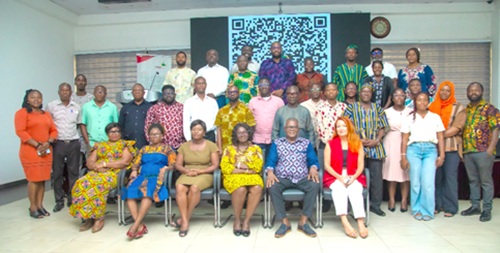
The lack of a policy means that their involvement is uncoordinated, amorphous and sometimes also duplicating," the Executive Director of Eduwatch, Kofi Asare, said yesterday when he presented a study conducted by his outfit on the Out-of-Pocket Costs of Free Basic Education in Ghana".
Study
The study showed that the country risked missing the Sustainable Development Goal (SDG) Four because of hidden costs borne by parents at the basic education level.
Per the study, parents paid for 10 items: examination fees, admission fees, extra classes fees, parent-teacher association (PTA) levies, textbooks, exercise books, uniforms, desks, Basic Education Certificate Examination (BECE) preparation fees and BECE placement fees.
That, it said, was in spite of the fact that the 10 items fall within public financing responsibilities.
Each of the items is provided for in the government education budget. They are fully funded at the second cycle level but neglected at the basic level.
The study, conducted among 200 parents and guardians in 20 districts from 65 schools in the country, was done in August this year, with data collected from the 2025-2026 academic year.
The study showed that 99 per cent of the respondents (198) had indicated that they had paid for at least one of the 10 cost items, with a median annual spend of GH¢620.67 per child.
It said three-quarters (76 per cent) of parents said their child had at some point been excluded from school activity because of non-payment.
Districts
It named the districts the survey was conducted in as Ablekuma North, Ablekuma South, Ayawaso Central, Ayawaso West, Bongo and Awutu Senya East.
The rest are Ga North, Ga East, Ga Central, Ga South, Ga West, Kpone Katamanso, La-Nkwatanang Madina, Ningo Prampram, Nkwanta South, Okaikwei North, Okaikwei South, Weija-Gbawe and Zabzugu.
Examination fees
Per the study, examination fees existed for 85 per cent of the respondents, with 82.5 per cent of them paying for PTA levies and 72.5 per cent for extra classes.
On learning inputs, the study showed that 66.5 per cent said they bought textbooks, with 64.5 per cent buying exercise books and 54 per cent buying uniforms.
It said entry and transition costs were lower: admission fee of 33 per cent, BECE preparation, 30.5 per cent and BECE placement 13.5 per cent of the parents/guardians.
