
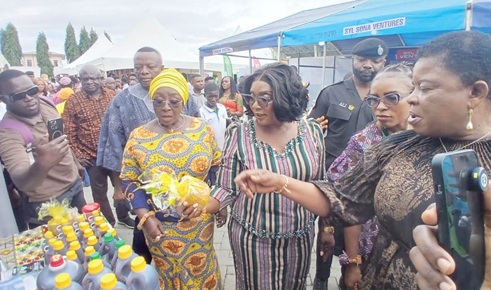
The 2026 Eastern Regional Trade and Investment Fair (Eastern Expo) has been organised in Koforidua with a call on stakeholders and investors to leverage the region's abundant resources to drive sustainable growth and development.
The week-long fair, held at the Koforidua Jackson Park, expected to end today was on the theme: "Unlocking Opportunities for Sustainable Trade, Tourism and Investment.
More than 400 exhibitors from all 33 municipal and district assemblies in the region and beyond had set up their booths, exhibiting goods including food, agricultural produce, handicrafts, clothing, among others.
The Expo, which was organised by the Eastern Regional Coordinating Council (ERCC) in partnership with the Ministry of Trade, Agribusiness and Industry, was to provide the opportunity to showcase the region’s economic potential.
Unemployment rate
The Presidential Advisor on the 24-Hour Economy and Accelerated Export Development, Augustus Goosie Tanoh, who represented President John Dramani Mahama to open the fair, said the government was targeting a reduction in Ghana’s unemployment rate below five per cent by 2035 under the 24-hour economy and Accelerated Export Development Programme.
He stated that the programme sought to increase manufacturing contribution to national output from about 10 per cent to 20 per cent.
Mr Tanoh described the 24-hour economy as a key component of the government's reset agenda aimed at driving a second wave of industrialisation in Ghana.
Economic transformation
He, however, identified the Eastern Region as one of the anchors of the economic transformation, stressing that the region would benefit significantly from the efforts to move the economy beyond the export of raw materials towards the production of finished goods.
According to Mr Tanoh, the programme had been designed to improve productivity and increase yields by addressing constraints that affect both demand and production.
That, he explained, would certainly require making raw materials available at competitive prices, improving supply-chain efficiency, ensuring reliable and affordable power, facilitating the movement of workers at night, improving access to working capital and developing the skilled workforce needed by industry.
Enabling environment
Mr Tanoh said the government’s focus had been to create an enabling environment, as well as better conditions necessary for businesses and factories to operate competitively, while expanding production and employment opportunities.
The Minister of Tourism, Culture and Creative Arts, Abla Dzifa Gomashie, said tourism, trade and investment were interconnected and could drive growth across sectors, including accommodation, agriculture, food, fashion, music, film, handicrafts and events.
She called for integrated tourism circuits to encourage visitors to stay longer and spend more, while promoting agro-tourism and food tourism to create opportunities for farmers, processors, women and young entrepreneurs.
Exporting raw materials
The Economic Advisor to President John Dramani Mahama and former Minister of Finance, Seth Terkper, who spoke on behalf of the Chief of Staff, Julius Debrah, said Ghana needed to move beyond exporting raw materials and depending on imported products.
For her part, the Eastern Regional Minister, Rita Akosua Adjei Awatey, called on investors to explore the region’s natural and human resources, describing the Eastern Region as a key destination for business and investment.
Mrs Awatey urged investors to make the region a top priority, citing its peaceful environment, security and business opportunities as factors that would position it to attract investment and serve as a gateway to the wider West African market.
