
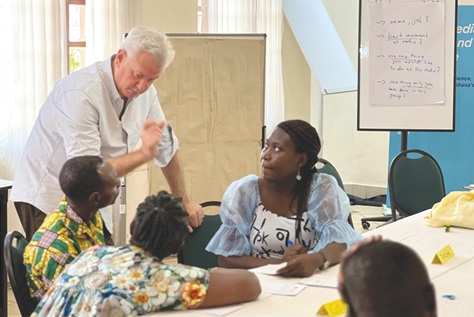
DW Akademie Ghana has trained representatives of three community radio stations in Ghana to strengthen the financial and operational sustainability of their stations.
The Community Radio Media Viability Training and Coaching programme, held under the European Union-funded African Media Integrity and Resilience Programme (AMIRP), equipped station managers, finance officers and editorial leaders with practical skills in revenue generation, financial management, audience engagement, governance and strategic planning.
The initiative was aimed at helping community radio stations become more resilient and better positioned to provide locally relevant information, amplify community voices, promote accountability and support development in their communities.
The participating stations were Radio Peace FM in Winneba in the Central Region, Radio Afram Plains in Donkorkrom in the Eastern Region and Radio PAD 95.1 FM in Damongo in the Savannah Region.
Holistic approach
A trainer, Guy Degen, said the training was designed to help participants look beyond the finances of their stations and consider other factors that contributed to their sustainability.
He said the training covered politics and governance, content and programming, technology and innovation, as well as community and audiences.
“It’s not just about the economics or budget, but it’s about looking at other dimensions,” he explained.
Mr Degen said community radio was particularly important because it was among the media platforms closest to local communities, with professional staff often working alongside volunteers who lived in the communities they served.
He said strengthening the sector was therefore important to helping the stations serve their communities better.
Shared responsibility
Mr Degen said the sustainability of a community radio station was not the responsibility of only the station manager, finance officer or journalist, but required the collective effort of staff.
He said the training encouraged participants to look beyond their individual roles and understand how their work could contribute to the overall viability of their stations.
Mr Degen said participants were also equipped with tools to identify solutions that could be adapted to the specific needs of their respective stations.
The Project Manager of the programme at DW Akademie, Cecil Ato Kwamena Dadzie, said community radio stations were often the primary source of information for underserved communities.
“Through this programme, we are supporting station leaders to strengthen their business models, improve management practices, and identify sustainable revenue opportunities so that they can continue serving their audiences effectively,” he said.
An Accounts Officer of Radio Peace FM, Winneba, Gorden Kumatey, said the training had exposed participants to practical approaches to improving the operations of their stations.
He said participants undertook exercises on media viability, including a Lego exercise, developing headlines and identifying what they wanted their stations to achieve by 2028.
Mr Kumatey said the practical exercises had helped participants to understand how the lessons from the training could be applied to their respective stations.
