

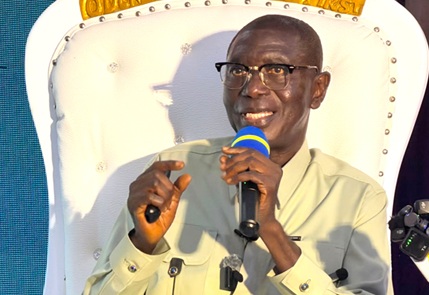
The President-General of the Centre of Awareness Global Peace Mission, Samuel Ato Duncan, has called for support for research into Real Intelligence (RI) as a possible new approach to addressing global conflicts and advancing human development.
He said RI focused on the deeper consciousness and inherent capabilities of human beings, signifying a distinct departure from Artificial Intelligence (AI), which depended on data and technological systems to perform tasks.
He said RI should be developed alongside AI to harness human consciousness and inherent intelligence in finding solutions to some of the world’s most pressing challenges.
“I’m making a passionate call to world leaders: we need artificial intelligence sometimes, but we should not be over-dependent on it. Real Intelligence is the way to go,” he stated.
Mr Duncan made the call at the launch of Real Intelligence in Accra, where he outlined a 38-year journey of research into human consciousness, peace and the inherent capabilities of human beings.
He said the initiative began in 1988 when, at the age of 22, he started seeking answers to fundamental questions about humanity and why sustainable peace had remained elusive despite decades of international efforts.
According to him, years of study, prayer, fasting and meditation eventually shaped the development of RI, and his broader vision for sustainable global peace.
Mr Duncan said the work culminated in a blueprint for sustainable global peace in 2024, with RI now being introduced as a tool to advance the agenda.
He said the continued existence of wars, conflicts and other threats to peace demonstrated the need to explore additional approaches to achieving sustainable peace.
Mr Duncan said peace should not be viewed solely as the absence of war, but should be anchored on values such as love, truth and respect for human life.
AI
He said the rapid development of AI had made research into human intelligence and consciousness even more important.
RI, he stated, existed within every person, and was rooted in the soul or inner consciousness.
He said further research was needed to determine how the concept could translate into technologies and practical solutions for peace, human development and other global challenges.
Mr Duncan then called for greater examination of fundamental questions surrounding human existence, including the origin, purpose and future of humanity.
“If you don’t know where you are coming from, definitely you wouldn’t know where you are going,” he said.
Creative energy
As part of his presentation, Mr Duncan introduced what he termed “creative energy”, which he described as the source of consciousness and the foundation of the universe.
He said he preferred the term creative energy because of the different religious and cultural interpretations associated with God.
“I’m talking about a creative energy that created the universe and created every spirit and created everything,” he said.
He identified love, truth and peace as fundamental principles associated with the concept, saying they provided a basis for peaceful coexistence.
Internet dependence
Mr Duncan also expressed concern over growing global dependence on internet infrastructure, warning of the consequences of a major disruption to digital systems.
He said further research into RI should explore new approaches to technological vulnerabilities and alternative solutions while subjecting the concept to scientific and technological investigation.
He, therefore, called for collaboration among governments, scientists, researchers and other stakeholders to examine the potential applications of RI in global peace, technological development and human advancement.
Oguaa support
The Paramount Chief of the Oguaa Traditional Area, Osabarima Kwesi Atta II, commended Prof. Duncan for his longstanding commitment to peace and the development of the RI initiative.
He pledged his support for Mr Duncan and the Centre of Awareness Global Peace Mission in their efforts to advance the initiative and promote sustainable peace.
Osabarima Kwesi Atta also called for broader stakeholder support for initiatives aimed at promoting peace and human development.
