
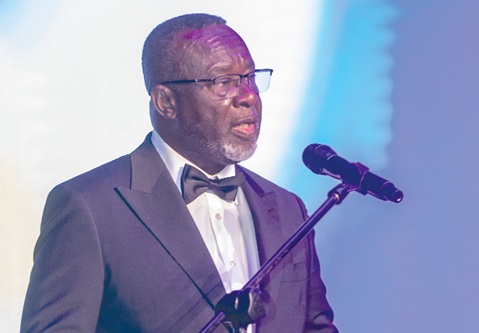
The Chief Justice, Justice Paul Baffoe-Bonnie, has cautioned journalists against turning court cases into media trials, warning that irresponsible reporting on pending proceedings could prejudice the determination of cases.
He said although the media had a legitimate role in scrutinising the judiciary and reporting on court proceedings, journalists must respect the constitutional presumption of innocence and avoid coverage that prejudged the guilt of accused persons.
The Chief Justice made the remarks at the 30th Ghana Journalists Association (GJA) Media Awards in Accra last Saturday.
The ceremony was attended by President John Dramani Mahama, the Speaker of Parliament, Alban Bagbin, other government officials, traditional leaders and members of the diplomatic corps.
The Ga Mantse, Nii Tackie Teiko Tsuru II, chaired the event, while the Asantehene, Otumfuo Osei Tutu II, Patron of the GJA, was represented by the Nkoranzamanhene, Nana Kwame Baffoe IV.
The ceremony had the theme: "Celebrating Excellence, Advancing Media Freedom and Combating Hate Speech in the Digital Age".
Justice Baffoe-Bonnie said reporting on cases before the courts required particular care, and that media coverage should not seek to influence the outcome of proceedings or create public conclusions before the courts had examined the evidence.
“A person accused of an offence remains innocent until proven guilty by a court of competent jurisdiction,” he said.
He distinguished between legitimate criticism of judicial decisions and attempts to intimidate the courts or replace judicial determination with public opinion.
“Criticism of judicial decisions is legitimate. Attempts to intimidate the courts or substitute public opinion for judicial determination are not,” he said.
Judicial independence
Justice Baffoe-Bonnie said the judiciary and the media occupied distinct but important positions in the country's constitutional order.
He cited Article 125 of the 1992 Constitution, which provides that justice emanates from the people and is administered in their name and on their behalf by an independent judiciary.
The Chief Justice said judicial independence was not a privilege for judges but a safeguard for citizens, ensuring that their rights and obligations were determined without fear, favour or improper influence.
“The media must remain free to scrutinise public institutions, examine the administration of justice and bring legitimate concerns to public attention, while the judiciary must remain open to legitimate scrutiny without compromising its independence,” he said.
Safety of journalists
The Chief Justice further called for greater protection of journalists, describing violence, threats, intimidation and harassment against media practitioners performing their professional duties as unacceptable.
He said journalists should not have to choose between reporting the truth and protecting their personal safety, adding that their protection was necessary to safeguard the public's right to information.
“The protection of journalists is not simply a matter of professional welfare. It is a necessary condition for the protection of the people's rights to know,” he said.
He urged stakeholders to work towards an environment in which journalists could investigate, report and express themselves without fear, stressing that press freedom was meaningful only when practitioners could exercise it safely and responsibly.
Justice Baffoe-Bonnie further urged journalists to uphold accuracy, fairness and respect for the rights of others, particularly in an era of digital publishing, artificial intelligence and the rapid spread of misinformation and disinformation.
