
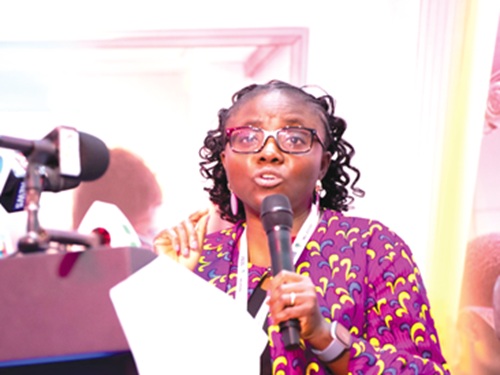
An official with the World Bank Group, Dr Ekua Bentil, has called for consistency and commitment towards the move to establish a National Digital Education Agency.
She admitted that though expensive, such an agency had the potential to move the country forward digitally, citing best practices from Korea and Uruguay as countries that were committed to consistency and sustainable approaches.
“I was happy to see that you plan to have the National Digital Education Agency.
It's not cheap to have, so I hope it will be fully funded, but I know that countries that have invested in these national digital education agencies have done well, and consistency is important,” she said.
Dr Bentil made the call at the opening of the 2026 Education Week, on the theme, “Harnessing artificial intelligence for inclusive and transformative education in Ghana.”
Addressing policymakers at the event as the guest of honour, she said, “AI is powerful, but you, the policymakers here, are more powerful.
“The teachers are more powerful.
What we do with this power is our responsibility.
We owe it to Ghana's children and youth,” she said.
Data foundation
She said Ghana needed a robust data foundation to effectively harness digital literacy, stressing, “Ghana will need to continue to lay the data foundations: electricity, connectivity, devices, and now quality education data.”
Dr Bentil said most African countries got stuck at the basic digital literacy level and therefore stressed the need “to start prioritising and skilling our students for the world out there”.
“So, prioritise secondary students and beyond. In primary, focus on teachers, and for students at that level, teach digital and AI safety with light-touch computer lab access,” she prescribed.
Dr Bentil said what was required of Ghana and the whole of Africa was to build creators, not just users, train developers and researchers in the universities who could adapt and fine-tune small language models and advance emerging AI research.
“We cannot be left behind.
There's so much going on with AI that we need a critical mass of people who understand how AI truly works.”
“Use AI where it adds the most value.
Focus on what helps teachers, what helps students learn, and what strengthens the education system as a whole,” she stressed.
Responsible AI use
Dr Bentil acknowledged that Ghana's AI strategy and its education system reinforce each other but said, “We need to think about how we build the skills of students, research partners and the local language content.
“The good thing is that the strategy highlights the AI in the curriculum, connectivity and computing investments, and then the data and privacy guidelines,” she said.
The Minister of Education, Haruna Iddrisu, emphasised that Ghana's ambition was to harness artificial intelligence to improve learning outcomes and expand educational opportunities, while empowering teachers with technology rather than replacing them.
He also called for responsible use of AI in education, cautioning that overdependence on the technology could weaken learners' critical thinking, creativity and problem-solving skills.
Speaking on the theme, the representative of the development partners, Andy Brooks, stated that artificial intelligence presented extraordinary possibilities for education.
“It could help teachers prepare lessons, adapt instruction to different learning needs, and identify where learners require additional support.
“It could also help education systems make better use of data and resources,” he said, but stressed that there was a need to also recognise the risks.
Mr Brooks, who is also the Country Representative of UNICEF, recalled that recent global research raised concerns about the potential impact of AI on children's learning and development, as well as their mental health.
“When students use AI to take shortcuts—skipping the hard work of critical thinking, problem-solving, and making mistakes—they may complete assignments more quickly without actually developing the skills and comprehension that they need.”
“There are also emerging concerns about the implications of AI for children's social relationships and their mental well-being,” he added.
Collective responsibility
He said the collective responsibility of Ghanaians and development partners was to ensure that innovation reached the most disadvantaged learners, including children in rural, underserved communities, children with disabilities, and those facing barriers to access quality education.
“This means designing solutions for Ghana's realities, including low-connectivity environments, local languages, and diverse learning needs,” he said, but added that the development partners were already working closely with the Government of Ghana to explore how AI could support national education priorities.
