
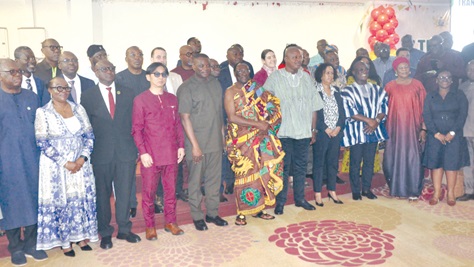
The President of the Volta Region House of Chiefs (VRHC), Togbe Tepre Hodo IV, has called for a bipartisan approach in delivering critical national transport infrastructure.
He said successive governments must create the environment for delivery of efficient roads, railways, ports, and airports, rather than making them political projects.
Speaking at a Transport Sector Review Conference in Ho last Wednesday, Togbe Tepre Hodo said delivering road infrastructure without the political fun-fair usually associated with such projects was crucial because the country needed continuity in major infrastructure development.
About 150 officials of the Ministry of Transport, Ministry of Roads and Highways, and representatives of various development partner organisations turned up for the two-day event on the theme: “Financing and delivery of resilient transport infrastructure and services – A big push for sustainable economic transformation.”
Topics discussed included financing infrastructure and transport services, resilient green mobility, accelerating regional integration, and digitising the transport sector, among others.
Priority
Togbe Tepre Hodo said the country must prioritise road infrastructure and the transport sector to facilitate development.
“A road is not a five-year construction project; it is a 20, 30 or 40-year public asset, while a railway is an operating system that requires maintenance, rolling stock, signalling, stations, energy and management,” he added.
Togbe Tepre Hodo, who is the Paramount Chief of Anfoega, said an airport also required continuous investment in safety, security, terminals, runways, and passenger services.
Economic connections
The Minister of Transport, Joseph Bukari Nikpe, said transport infrastructure was no longer about constructing roads, bridges, ports, airports or transit systems.
“It is about creating physical and economic connections that allowed people, farmers, and communities to participate fully in the national economy,” he said.
Mr Nikpe said such interventions required vigorous mobilisation of additional resources, efficient use of funds, and strengthening of management to attract private capital to develop innovative financing mechanisms to sustain funding and maintenance.
“This is why the government has placed the Big Push infrastructure programme at the centre of its development agenda,” he said.
Significance
For his part, the Minister of Roads and Highways, Kwame Governs Agbodza, said the success of the Big Push project was not only in the kilometres of roads constructed, but in the economic opportunities created, travel times reduced, communities connected, businesses enabled, and livelihoods improved.
“Under the Big Push, substantial progress is being made on major regional arteries, including the Suame Interchange Phase Two, the Kumasi and Sunyani outer ring roads, and the dualisation and interchange projects along the Kosoa-Winneba and Takoradi-Agona Junction corridors,” he said.
Mr Agbodza said the Accra-Kumasi Expressway’s feasibility and detailed engineering studies were nearing completion.
The projects demonstrate the government’s commitment to developing a modern, efficient, and intercontinental national transport network, he added.
