
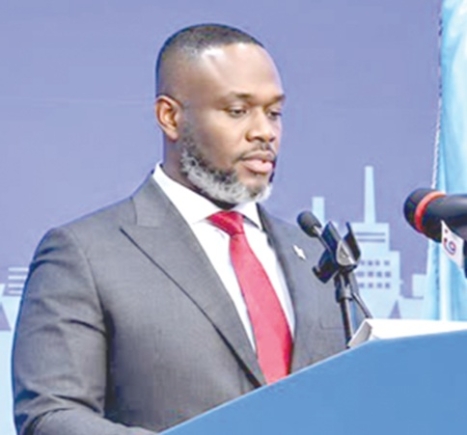
The Minister of Defence, Gilbert Kenneth Adjei, has called for a coordinated, intelligence-led response to maritime insecurity in the Gulf of Guinea, saying criminal networks do not respect borders.
Mr Adjei made the call in Accra on Wednesday, at the opening of the First African Maritime Security Forum at the Kofi Annan International Peacekeeping Training Centre (KAIPTC), his first formal engagement as Chairman of the KAIPTC Governing Board.
He said the nation was proud to contribute to the safety of the Gulf of Guinea, stressing that the sea was a source of livelihood, a strategic avenue for trade and a shared space indispensable to national and regional prosperity.
"The threats confronting our societies do not respect borders, domains or jurisdictions. Criminal networks exploit the connections between sea, land and air.
"No country is capable of confronting these threats in isolation.
Our response must, therefore, be coordinated, intelligence-led and sustained by trust among nations and institutions," he said.
The minister added that maritime security cannot be managed in isolation from developments on land or in the air and, therefore, requires cooperation across governments, industry, regional bodies and international partners.
Mr Adjei said the success of the meeting should be measured not only by discussions but by partnerships to ensure that "waters that connect our nations must not become corridors for criminality and insecurity.
They must remain avenues for lawful trade, cooperation and shared prosperity."
Forum
The forum is a collaboration with KAIPTC, the Royal Danish Defence College and the Security Institute for Governance and Leadership in Africa (SIGLA) at Stellenbosch University.
The maiden edition had 66 registered participants from 14 countries, including Ghana, Kenya, Cameroon, Togo, South Africa, Cape Verde, Madagascar, Nigeria, Côte d’Ivoire, Sierra Leone, Denmark, France, the UK, and the US.
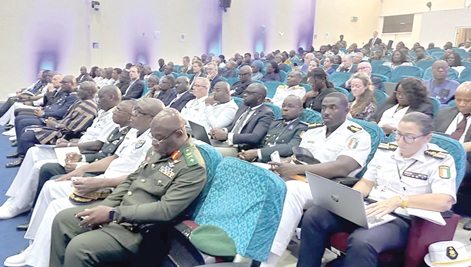
Participants in the Africa Maritime Security Forum
It was on the theme: “The African maritime landscape in times of geopolitical uncertainty in 2026 and onwards."
Focus
The Commandant of KAIPTC, Air Vice Marshal David Anettey Akrong, said the forum would focus on innovative strategies, technology adoption, robust legal frameworks and actionable recommendations to strengthen Maritime Domain Awareness and cross-regional policies.
He said piracy in the Gulf of Guinea had dropped significantly due to regional frameworks such as the Yaoundé Architecture and sustained joint patrols, but that the underlying drivers of insecurity remained persistent and adaptive.
The Commandant blamed weak naval capacity, poor coastal governance, youth unemployment and pollution for persistent instability.
He also mentioned a resurgence of Somali piracy and crimes such as smuggling, trafficking and illegal fishing, which were threatening food and economic security.
The Commandant added that Southern Africa's Cape Sea Route was now absorbing significant global shipping traffic rerouted from checkpoints such as the Red Sea, Bab el-Mandeb and the Strait of Hormuz, proving that maritime crises beyond African shores had a direct impact on African waters.
Commitment
The Danish Ambassador to Ghana, Jakob Linulf, said Denmark, as a seafaring nation home to some of the world's leading shipping and logistical companies, placed great importance on freedom of navigation and safety of seafarers who moved about 90 per cent of global trade.
He said Denmark had, for over a decade, partnered the Gulf of Guinea and Horn of Africa states to curb piracy, training over 1,000 security officers, while building training facilities in Ghana and Nigeria.
The ambassador, however, acknowledged that the maritime security environment was still evolving, with geopolitical tensions in the Middle East threatening major trade corridors and diverting vessels around the Cape of Good Hope and through the Gulf of Guinea, placing additional pressure on Africa's coast.
Mr Linulf said this development underscored the need for stronger national ownership, enhanced regional cooperation and Africa-led solutions.
