
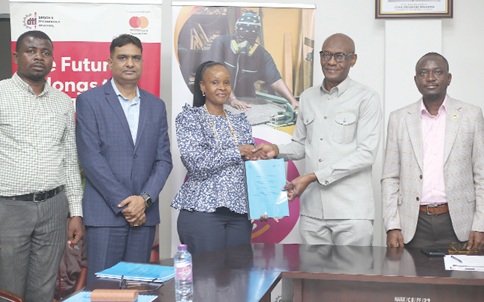
The Commission for Technical and Vocational Education and Training (CTVET) and the Design and Technology Institute (DTI) have signed a Memorandum of Understanding (MoU) to strengthen and transform Ghana's technical and vocational education and training system.
The agreement, signed last Monday, establishes a strategic framework for collaboration aimed at improving the quality, relevance and results of TVET delivery across the country.
The MoU runs for three years and opens the door for joint resource mobilisation with government, industry and development partners, including the African Development Bank and the World Bank.
The partnership will also strengthen institutional and human capacity across both public and private TVET institutions, align training with national development priorities and industry needs and support the development of national TVET systems, frameworks, and digital infrastructure.
It will also promote globally benchmarked skills, standards and training methods, and build ethical and structured pathways for skilled and certified Ghanaian youth to take up opportunities abroad.
Speaking at the signing ceremony, the Founder of DTI, Constance Swaniker, noted that DTI's programmes were accredited from the institute's inception, and its Precision Quality curriculum is itself accredited by CTVET.
"This is not a programme to train several people and report the figure. Our ambition is the ecosystem itself, the institutions and systems that sit beneath every training programme in this country.
“We are moving from training individuals to transforming systems in a way designed from the outset to be sustainable, scalable and nationally owned," she stated.
Ms Swaniker outlined the agreed scope of the partnership, which includes building the capacity of trainers, assessors, standards generators and institutional leaders, as well as extending the Precision Quality framework across the TVET landscape.
The collaboration will also contribute to the National Human Capital Development Policy and national qualifications frameworks and support the Skill Development Management System and the Labour Market Information System.
Additionally, the partnership will establish the DTI Pan-Africa TVET Trainer Academy at Berekuso and open structured pathways for certified Ghanaian youth into global labour markets.
Ms Swaniker emphasised that national regulation and global recognition were not competing demands, noting that DTI secured international accreditation through the American Welding Society, Pearson and NOCTI in response to industry requirements.
Industry
The Director-General of CTVET, Dr Eric Kofi Adzroe, described DTI as one of Ghana’s fastest-growing private TVET institutions, attributing its growth to the quality of its training and strong industry linkages.
"A certificate means more when the learner who holds it is recognised by employers.
DTI's presence in industry leads to greater employment outcomes for its learners, and that is the result every TVET institution in Ghana should be aiming for," he said.
He explained that the MoU establishes a strategic framework for collaboration, with CTVET providing policy leadership, strategic direction, regulatory oversight and national coordination.
On financing, Dr Adzroe stated that programmes might be funded by government, development partners, the private sector, philanthropic organisations, and innovative financing structures, with emphasis on accountability and sustainability.
"The signing today is the start of the work.
The real test will be in the results: better-trained learners, stronger institutions, and more young Ghanaians in decent work," he added.
