

The usual quiet of the Efua Sutherland Children's Park gave way to the smell of smoked fish, fresh mushroom soup, and brewed cocoa as the Council for Scientific and Industrial Research (CSIR) opened its three-day Innovation Fair.
The fair, which ran from Friday (Oct 16) through the weekend, was the public exhibition component of the CSIR Scientific Conference and Innovation Fair 2026.
It had the theme, “From Research to Market: The Role of CSIR in Driving Innovation for National Development.”
It followed two days of scientific discussions at CSIR’s head office on October 14 and 15, with the exhibition providing an opportunity for researchers to connect with farmers, businesses, investors and potential customers.
The exhibition coincided with World Food Day celebrations, with over 50 stalls showcasing agricultural produce, improved seeds, rice varieties, tomatoes, tomato puree, tubers, coconut planting materials and innovations in poultry feed.
The remaining booth demonstrated technologies developed by research institutions and private enterprises, including improved crop varieties, soil management systems, renewable energy solutions and engineering innovations.
Investors, farmers, students, and market women moved from stand to stand tasting, asking prices and scanning quick response (QR) codes for licensing.
The mood was less of an academic conference and more of a market.
With researchers and potential customers sharing the same exhibition space, the fair created opportunities to discuss how locally developed technologies could move into commercial production and reach more people.
Platform
CSIR comprises 13 research institutes working across agriculture, food, industry, natural resources and engineering.
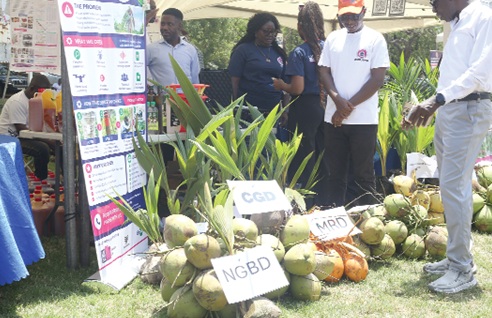
Some products displayed during the exhibition
The fair helped the research institutes identify commercial partners and connect their technologies with potential users.
Farmers, food processors, manufacturers, retailers and investors had opportunities to engage directly with researchers to explore product purchases, distribution, technical collaboration and technology transfer.
Visitors could purchase selected products directly from exhibitors, while businesses assessed innovations for possible adoption, investment or commercial production.
In addition to the exhibition, the programme featured training sessions, practical demonstrations, seminars and lectures on commercialising scientific research.
The event sought to move locally developed technologies beyond research facilities into farms, factories, markets and households, creating opportunities for enterprise development, employment and improved livelihoods.
Innovations
Among the notable innovations was an improved Ahotor fish-smoking oven developed to reduce smoke exposure during fish processing.
The technology offered an alternative to traditional smoking methods, which exposed processors to smoke and contributed to environmental pollution.
An agricultural venture, Bio Green Agro, also displayed the use of algae in fish farming to minimise pollution and create double value for crop and fish farming.
The CSIR-Food Research Institute (FRI) showcased high-protein biscuits, instant fufu flour and plantain chips made from improved varieties, demonstrating opportunities to add value to locally produced crops and expand food processing.
At the CSIR-Crops Research Institute (CRI) stand, researchers presented pod borer-resistant cowpea and climate-smart rice breeding materials. These technologies were designed to help farmers address pest-related losses and challenges associated with changing climatic conditions.
The CSIR-Soil Research Institute (SRI) demonstrated nano-fertiliser technology, hydroponic systems and a mobile soil-testing laboratory.
The exhibits highlighted approaches to improving soil management, supporting informed fertiliser use and growing crops with limited water.
The hydroponic display, which included lettuce and strawberries grown in vertical polyvinyl chloride (PVC) pipes, demonstrated the potential of space-efficient crop production in urban areas.
In construction, the CSIR-Building and Road Research Institute (BRRI) presented low-carbon concrete and interlocking bricks made from local laterite.
The institute also demonstrated improved cookstoves and briquette technology using sawdust and cocoa husks, offering potential applications for waste recovery and alternative energy.
The CSIR-Institute for Scientific and Technological Information (INSTI) demonstrated three-dimensional (3D) printing services.
Agriculture, local production
The CSIR-Savanna Agricultural Research Institute (SARI) presented improved crop varieties and agricultural technologies, while the Oil Palm Research Institute (OPRI) and Plant Genetic Resources Research Institute (PGRRI) showcased resources and technologies relating to oil palm, coconut and other plant species.
The Animal Research Institute (ARI) provided information on animal health and livestock production to livestock and poultry farmers, while the CSIR-Forestry Research Institute of Ghana (FORIG) exhibited precursor tea in different flavours.
The CSIR-Institute of Industrial Research (IIR) presented engineering, fabrication and renewable energy solutions.
Skincare products, clothing and other locally developed consumer goods were also displayed, reflecting the range of products that research and innovation could support across different industries.
