
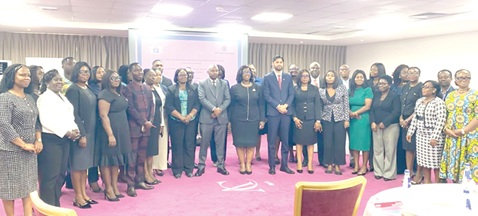
The Commonwealth Secretariat is supporting Ghana to build the capacity of its National Mechanism for Implementation, Reporting and Follow-up (NMIRF) on human rights.
The Human Rights Adviser at the Commonwealth Secretariat, Yashasvi Nain, said the mechanism could help institutions share information and streamline reporting across different frameworks on human rights.
This would also help the country address the country’s treaty-body reports that had been overdue for more than five years, with some outstanding for between five and 10 years.
“Instead of duplicating their reporting work, they can streamline and submit these reports on time and reuse the information when they submit to one reporting process, and reuse the same information for the other reporting process,” he said.
Mr Nain said the secretariat would continue to provide support beyond the workshop through remote assistance with report preparation and mock sessions to prepare Ghanaian delegations for engagements with international human rights committees.
He said some of Ghana’s treaty-body reports had been overdue for more than five years, with some outstanding for between five and 10 years.
Mr Nain, however, explained that countries faced numerous reporting obligations under different international and regional frameworks, which could result in delays and duplication of work.
He said the country had been submitting its reports under the Universal Periodic Review (UPR) on time, but some reports required under international human rights treaties remained outstanding.
He said Ghana’s next UPR review was scheduled for January 2028, with the national report expected to be submitted late in 2027.
Mr Nain was speaking at a three-day workshop in Accra on Tuesday, aimed at boosting international reporting on human rights reporting obligations, and also improve its implementation.
It is being organised by the Commonwealth Secretariat, in collaboration with the Office of the Attorney-General and Ministry of Justice.
In attendance included representatives of ministries, departments and agencies (MDAs), and civil society organisations (CSOs) which share information, identify reporting gaps and improve coordination in the preparation of reports and implementation of recommendations from international human rights mechanisms.
It is also expected to produce a coordinated action plan to address outstanding treaty-body reports, strengthen the monitoring of recommendations and establish clear responsibilities and timelines for the institutions involved.
The Solicitor-General, Helen Akpene Awo Ziwu, who delivered the speech on behalf of the Attorney-General and Minister for Justice, Dr Dominic Akuritinga Ayine, said the reporting process required sustained cooperation among public institutions.
He said the effectiveness of the NMIRF depended on institutions providing accurate, current and verifiable information within their respective mandates.
“No single Ministry, Department or Agency possesses all the information required to provide a complete account of Ghana’s human rights performance,” he added.
Dr Ayine, therefore, urged participating institutions to maintain reliable records and provide evidence of implementation, outcomes and outstanding challenges to ensure that reporting did not become a last-minute exercise.
He said the success of the mechanism would ultimately be measured by its contribution to effective implementation, stronger accountability and tangible progress in protecting human rights, rather than the number of meetings held or reports submitted.
Recommendations
The Executive Director of POS Foundation, Jonathan Osei Owusu, welcomed the initiative, saying the institutionalisation of the reporting mechanism would help ensure that recommendations received by the country were monitored beyond periodic international reviews.
He cited the passage of the Right to Information Law and the Community Service Bill as examples of progress on recommendations made during previous UPR cycles.
“We pride ourselves as a state that is taking up the recommendations and not closing the books after the review,” Mr Owusu said.
