
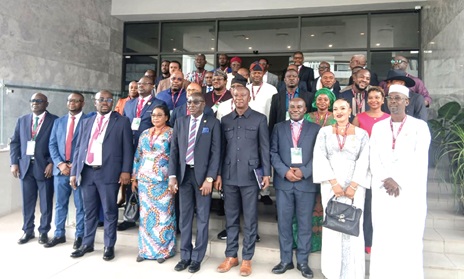
Speakers at a seminar on the prevention of financial crimes and enhancing public finance management have urged Public Account Committees (PACs) of the parliaments of ECOWAS countries to collaborate with other sectors, including financial intelligence units (FIUs) of their respective countries in order to enhance public finance management and prevent financial crimes.
They said preventing financial crimes was something no single institution could address alone, pointing out that success depended on strong collaboration, cooperation, information sharing and coordinated action among all relevant stakeholders.
They have, therefore, called for strengthening of referral mechanisms, improved implementation of audit recommendations, and improved collaboration among PACs, FIUs, anti-corruption institutions, law enforcement agencies, civil society organisations, and the media.
The speakers were the Head of Mutual Evaluation and Regional Compliance of the Financial Intelligence Centre (FIC), Seth Nana Amoako; the Director General of ECOWAS’ Inter-Governmental Action Group against Money Laundering in West Africa (GIABA), Edwin W. Harris; the Secretary General of the West African Public Accounts Committee, Clarence Gahr, and the Coordinating Director, Technical, of the Ministry of Finance, Samuel D. Arkhurst.
They said this last Wednesday at the opening of the second seminar on preventing financial crimes and enhancing public finance management through parliamentary Public Accounts Committees organised by GIABA for PAC members in ECOWAS countries.
Public Accounts Committees of Parliament ensure that audit findings are translated into parliamentary scrutiny, accountability and reform, thereby strengthening transparency, governance and public confidence in state institutions.
The seminar was, therefore, meant to build the capacity of members of PAC to perform their roles effectively and also for GIABA and PAC to collaborate going forward.
GIABA is an ECOWAS institution with a mission to defend the economy of member states against the scourge of money laundering, terrorist financing and proliferation financing.
Mr Amoako said through partnership, PAC could close vulnerabilities that enabled financial crime and strengthen accountability in the management of public resources.
He affirmed the FICs commitment to work closely with all national, regional and international partners to safeguard public resources and strengthen financial integrity.
“Ultimately, strong cooperation ensures that identified risks are able to address them and also build public confidence that resources are managed transparently in the best interest of citizens,” he said.
“Our public account committees, you are the constitutional guardians of the public purse.
You are the critical link between the fairness of our supreme public institution and the enforcement of accountability.
When you go through and interrogate expenditures, demand explanations, and insist on corrective action, you do not only protect taxpayer resources; you disrupt the nature of corruption, shrink the webmaster of illicit flow, and strengthen the foundation of our democratic institutions.
Your oversight is not procedural formality; it is national security imperative,” Mr Harris said.
He said Africa was estimated to lose over $88.6 billion every year to corruption and illicit financial flows and that represented classrooms that were ruined, hospitals without equipment, infrastructure left on the drawing board and the future opportunities denied to the youth.
Mr Gahr said as the pillar of accountability of parliament, if PACs put their strengths together and coordinate with anti-financial institutions, they could do the work effectively.
He said if West Africa, and for that matter Africa, could reduce by half the amount of money it lost to financial crimes, then there would be no need for it to go to the West to borrow money.
Mr Arkhurst, who spoke on behalf of the Minister of Finance, Dr Cassiel Ato Forson, said they expected strong collaboration between PAC and other institutions as well as cooperation among jurisdictions, be it Nigeria, Senegal or Cote d’Ivoire.
“We want the cooperation and sharing information to enhance the fight against corruption and strengthen public accountability,” he said.
