
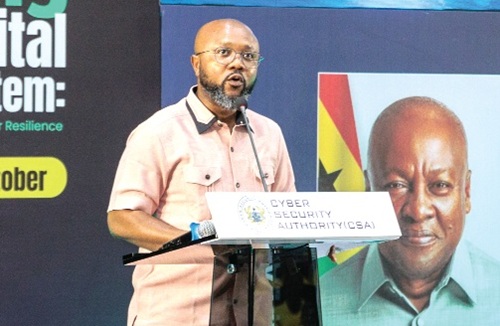
The Director-General of the Cyber Security Authority (CSA), Divine Selase Agbeti, has called for closer collaboration among financial institutions, fintech companies, telecommunications operators and law enforcement agencies to combat growing cyber threats to Ghana’s digital finance ecosystem.
He said the rapid expansion of digital financial services had created significant opportunities for businesses and consumers but had also increased the avenues available to cybercriminals to attack financial institutions and defraud users.
Mr Agbeti made the call at the launch of the 2026 National Cyber Security Awareness Month (NCSAM) in Accra last Thursday.
The month-long activities are being carried out on the theme: “Securing Ghana’s Digital Finance Ecosystem: Building Trust Through Collaboration and Cyber Resilience.”
He said cybersecurity could no longer be treated solely as an information technology issue, describing it as an economic and national security concern that was increasingly linked to public confidence in digital financial services.
The country’s digital economy has expanded rapidly, with millions of people using mobile phones and digital platforms to transfer money, pay bills, purchase goods, access banking services and conduct business.
Mr Agbeti said while the transformation was creating new economic opportunities, it was also creating a larger attack surface for cybercriminals.
“When a Ghanaian loses money to cyber fraud, we lose more than money.
We lose confidence,” he said.
The Director-General of CSA explained that loss of confidence in digital platforms could have consequences beyond individual victims, affecting financial inclusion, electronic commerce, innovation and the country's broader digital transformation agenda.
Collaboration
The CSA Director-General said cybercriminals did not operate within institutional boundaries and could exploit gaps between banks, fintechs, telecommunications companies, regulators and law enforcement agencies.
He, therefore, called for the sharing of actionable threat intelligence and faster coordination among institutions to enable attacks to be detected, disrupted and contained before they cause significant losses.
Mr Agbeti said the effectiveness of collaboration should not be measured by the number of agreements signed, but by how quickly institutions could detect threats, share information, respond to incidents and recover from attacks.
He also urged boards and chief executives of financial and digital businesses to treat cybersecurity as a business risk rather than an issue confined to technology departments.
The Director-General of CSA said senior executives needed to know how quickly their organisations could detect and contain an attack, maintain critical operations during a disruption and recover affected systems.
AI threat
Mr Agbeti added that the growing use of artificial intelligence (AI) was adding another dimension to the cyber threat landscape.
He added that although AI could improve customer service and other business processes, criminals could also use it to create convincing impersonations, phishing messages and sophisticated social-engineering attacks.
He urged the public to verify unexpected requests for money or sensitive information and protect passwords and authentication credentials.
“In the age of artificial intelligence, seeing is no longer necessarily believing. Verification must become a habit,” he said.
The CSA also warned cybercriminals that operating across borders would not place them beyond accountability.
Mr Agbeti said the Authority would continue working with law enforcement, intelligence, regulatory and international partners to identify, investigate and disrupt cyber-enabled crime.
He called on financial institutions, fintechs, telecommunications companies, technology providers, public institutions and citizens to actively participate in NCSAM 2026.
