
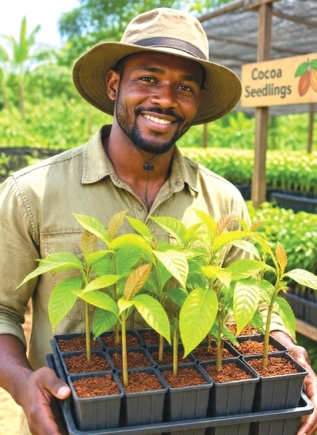
The Ghana Cocoa Board (COCOBOD) is stepping up efforts to make cocoa production more environmentally sustainable with the introduction of a soil-free technology for raising cocoa seedlings.
The technology, developed locally, provides an alternative to the traditional practice of raising seedlings with topsoil in polythene bags and is expected to help reduce soil degradation and plastic waste associated with cocoa nursery operations.
The soilless media is made of milled coconut husk and infused with Nitrogen, Phosphorus, and Potassium (NPK), making it bosst crop development for nine months, which the scientists explained outperformed the traditional nursery that used plastic bags.
Besides, the plastic receptacles are reusable, making it environmentally sustainable.
Training
As part of efforts to facilitate its adoption, Chrysfibre, a Ghanaian company specialising in soilless growing media and alternative nursery receptacles, in collaboration with GKC Structures Ltd, has trained officers of COCOBOD’s Seed Production Division (SPD) at the Cocoa Research Institute at Tafo in the Eastern Region.
The training follows three years of engagement between COCOBOD and Chrysfibre to explore and promote environmentally friendly methods of raising cocoa seedlings.
Participants were taken through the handling, preparation and use of the soilless growing media and alternative nursery receptacles for producing cocoa seedlings and other planting materials.
Traditionally, cocoa seedlings are raised using topsoil packed into polythene bags. However, sourcing the soil involves removing fertile topsoil, which could contribute to land degradation and loss of productive land when poorly managed.
Conventional polythene bags are also non-biodegradable and can remain in the environment for many years. The new technology seeks to eliminate the continuous stripping of topsoil while reducing the use and disposal of polythene bags in cocoa nurseries.
The Executive Director of the SPD, Dr Francis Kwame Padi, said equipping officers with the requisite skills was critical to the successful adoption of the technology.
“The training is important because it gives our officers the knowledge and practical skills to work with new technologies that can improve cocoa seedling production while protecting the environment,” he said.
The Finance and Administrative Officer of Chrysfibre Ltd, Joseph Evans Tetteh, said the partnership with COCOBOD was aimed at ensuring that officers properly understood and applied the technology.
“The essence of this training is to build the capacity of the officers so they can properly handle and use the technology.
We believe that collaboration with COCOBOD is important in taking this innovation to the next level,” he said.
Fear of decline
The initiative comes as the country’s cocoa output is projected to decline by at least 16 per cent in the 2026/27 season due to weather conditions, the crop’s natural bearing cycle and disease.
Production reached about 771,000 tonnes in 2025/26, compared with approximately 600,000 to 620,000 tonnes in the previous season.
COCOBOD is consequently rehabilitating disease-infected farms, expanding spraying programmes and restoring free fertiliser distribution for the 2026/27 season.
The rehabilitation programme requires a steady supply of healthy planting materials.
The soil-free technology is, therefore, expected to support COCOBOD’s broader objective of combining quality cocoa seedling production with environmental conservation and sustainable cocoa production.
