
Unpredictable rainfall, rising temperatures and floods are putting farming communities in the North East Gonja District in the Savannah Region under increasing pressure.
At the same time, growing demand for firewood and charcoal is driving tree felling and threatening the vegetation on which rural livelihoods depend.
Trucks and tricycles transport dried wood from North East Gonja and other parts of the Northern and Savannah regions to Tamale, where it is sold to bakers, shea processors, pito brewers and other businesses.
For many residents, however, tree felling and charcoal production remain important sources of income, particularly for women with limited employment opportunities during the dry season.
The Member of Parliament (MP) for Salaga North, Alhassan Mumuni, says efforts to address the practice must, therefore, go hand in hand with the provision of alternative livelihoods.
He is proposing to engage between 500 and 600 young people in tree planting, the cultivation of economic trees and other forest-related activities from 2027.
The programme was expected to cover all 12 electoral areas, with participants receiving monthly allowances.
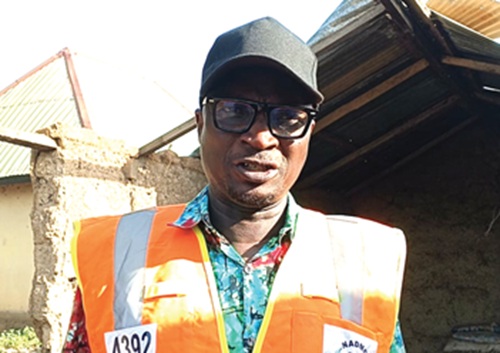
Speaking to the Daily Graphic after presenting relief items to 288 flood victims at Bunjai, Alhaji Mumuni said changing rainfall patterns, floods and bushfires called for urgent action to protect the environment.
“The harvesting of trees has caused a lot of climate change-related effects on our people, and so we think that there is a need for us to intensify education on climate change,” he said.
With most households dependent on rain-fed agriculture, uncertainty over the onset and duration of the rainy season makes it difficult for farmers to plan land preparation and planting.
Alhaji Mumuni said sustained tree planting, forest plantations and the cultivation of economic trees could help restore vegetation, while public education would enable residents to understand the consequences of indiscriminate tree felling.
He said appeals to residents to stop felling trees and producing charcoal would not be enough without providing alternative sources of income.
Recalling his time as Assembly Member for the Gbun Electoral Area, he said many women depended on those activities because they had few alternative livelihood opportunities.
“The women in our areas do not have any employment opportunities, and so they are into these activities.
It will be very difficult to ask them to stop the cutting of trees and the burning of charcoal,” he said.
Conservation
Youth groups would be formed across the 12 electoral areas, with membership determined by the population and geographical size of each area.
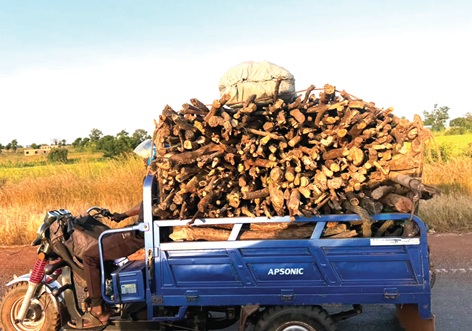
A tricycle conveying freshly cut dried wood
The Forestry Commission is expected to supply improved tree seedlings, while the Department of Agriculture would provide seedlings for food crops.
The Tree Crops Development Authority was also expected to support the cultivation of shea, cashew and other fruit trees.
Alhaji Mumuni said implementation was scheduled to begin in 2027, with monthly allowances to be funded by his office with support from the District Assembly.
Alhaji Mumuni said his office was supporting women with tractor services on credit, improved seedlings, start-up capital and other farm inputs to help them generate income and meet household expenses, including education and healthcare costs.
He said his office was also working towards a collaboration with the Ghana Cylinder Manufacturing Company to educate and train women in the use of liquefied petroleum gas (LPG) for domestic cooking.
The proposed collaboration is intended to promote LPG as an alternative to firewood and charcoal.
Alhaji Mumuni said traditional authorities, Assembly Members, Unit Committee members, District Chief Executives and MPs all had roles to play in educating residents and supporting environmental protection.
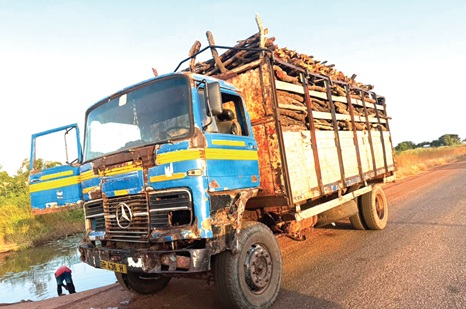
A truckload of freshly cut dried wood being transported from North East Gonja to Tamale
He called for stronger measures to address indiscriminate sand winning and illegal mining, which he said were contributing to environmental degradation.
He also urged the government to strengthen climate change mitigation programmes and called on the United Nations and its agencies to support public education and environmental restoration in vulnerable communities.
The proposed initiative seeks to link environmental conservation with job creation, but its success will depend on sustained funding, effective institutional coordination and community participation.
Alternatives
A resident, Mohammed Alhassan, said many households relied on tree felling and charcoal production for income during the dry season, when farming activities declined.
He warned that efforts to stop the practice would be unsuccessful without alternative livelihood opportunities.
“You cannot stop people from engaging in an activity from which they earn an income without providing them with an alternative source of livelihood,” he said.
He urged the government to complement afforestation programmes with livelihood support, particularly for women and young people, and promote irrigation and dry-season farming.
For residents of North East Gonja, the challenge is not simply to persuade them to stop cutting trees, but to make protecting the environment a viable means of securing their livelihoods.
