
China's imports from Ghana rose by 166 per cent month-on-month to $290 million in June this year, following the implementation of China's zero-tariff policy on products from African countries, the Chinese Ambassador to Ghana, Cong Song, has disclosed.
He said the figure also represented a 6.1 per cent year-on-year increase and accounted for 27 per cent of China's total imports from Ghana in the first half of 2026.
He said the figures demonstrated the growing opportunities for Ghanaian exporters under China's decision to grant duty-free access to products from 53 African countries with which it maintained diplomatic relations, including Ghana, effective May 1, 2026.
Under the new non-reciprocal tariff regime for Africa, cocoa, which previously attracted tariffs of between eight and 22 per cent, will now enjoy duty-free access to the Chinese market, alongside products such as cashew nuts, shea butter, textiles and handicrafts.
“China is Ghana's largest trading partner and a major source of investment, and bilateral trade between China and Ghana reached a record high of $14.12 billion in 2025. Among them, Ghana’s exports to China reached $2.67 billion, a year-on-year increase of 33.9 per cent, with the growth rate far exceeding that of imports from China," he said.
Market access
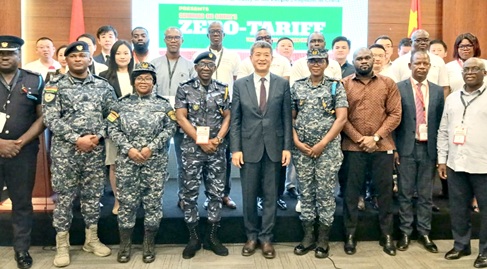
At the 2026 Scholarship Alumni Association Reception and China-Ghana Zero-Tariff forum in Accra last Friday, Mr Song said the policy would lower the cost of exporting Ghanaian products to China, improve their competitiveness and provide local businesses with access to the Chinese market of 1.4 billion people.
He said the initiative was part of China's commitment to expanding economic opportunities for African countries at a time when unilateralism and protectionism were increasingly disrupting international trade.
The forum was meant to educate and prepare Ghanaian businesses, particularly exporters, to take advantage of China's decision to grant eligible African countries, including Ghana, duty-free access to the Chinese market.
It was jointly organised by the Mofcom Scholars Alumni Association of Ghana (MoSAAG) — an association of Ghanaian public and private sector professionals who graduated from Chinese Ministry of Commerce (MOFCOM) scholarship programmes.
Duty-free access
"With the implementation of the zero-tariff treatment, products such as cocoa enjoy zero tariffs on exports to China, significantly lowering the cost of entering the Chinese market," the Chinese Ambassador said.
Mr CONG added that the removal of tariffs would give Ghanaian products a price advantage and create opportunities for local exporters to expand their market share.
"The price advantage unlocked by this policy will translate into a larger market share for African goods in China," he stated.
Mr CONG said the policy was not limited to expanding trade but was also intended to attract investment into Africa's manufacturing and processing industries.
Build production capacity
The Chinese Ambassador said improved access to the Chinese market would make it commercially viable for investors to establish factories and processing facilities in African countries to prepare products for export.
He said such investments could bring capital, technology, equipment and managerial expertise into Ghana, while creating economic opportunities for farmers and small businesses.
Increase investment
In an address read on his behalf, the Minister of Foreign Affairs, Samuel Okudzeto Ablakwa, called for stronger Chinese investment in Ghana's manufacturing and processing industries to ensure that the benefits of China's zero-tariff policy translated into job creation, technology transfer and economic transformation.
He said Ghana wanted a partnership that promoted local production and value addition rather than continued exports of raw materials.
"The real measure of a successful partnership is not simply how much we trade but how sustainable the trading arrangements are," Mr Ablakwa said.
The President of MOSAAG, Leonard Edem Cosmos, urged members of the association to actively support its drive by mentoring regional small-scale enterprises, demystifying Chinese regulatory frameworks and connecting credible Ghanaian suppliers with verifiable Chinese partners.
